
THE CONTEXT OF SCOUTING: PART 4 – ASSESSING PLAYERS AGAINST DIFFERENT LEVELS OF OPPOSITION
- 2 July 2026
- Ged Searson
- 0


THE CONTEXT OF SCOUTING: PART 4
ASSESSING PLAYERS AGAINST DIFFERENT LEVELS OF OPPOSITION
Why Context Changes Every Performance
“You deal in hard facts and you must never back hunches. Watch a player in different conditions, not just at home, but in tough away matches when they will be under pressure.”
– Brian Clough
Every scouting report begins with what appears to be a straightforward question.
How well did the player perform?
Professional recruitment departments know that isn’t the real question.
The real question is:
Against whom?
One outstanding performance can look very different once the quality of the opposition is considered.
Professional football scouting is not simply about assessing players.
It is about assessing performances in context.
Every opponent asks different questions.
Every performance provides different answers.
Continue Reading
Enter your email to unlock this full article and join the AFCAS coaching & scouting community.
No spam. Unsubscribe anytime.
The professional scout’s responsibility is to understand both.


THE OPPOSITION IS PART OF THE ASSESSMENT
Every match presents a different challenge.
A striker dominating against a team at the bottom of the table is not facing the same defensive quality as a striker playing against the league leaders.
A midfielder enjoying time and space against weaker opponents may find themselves under constant pressure against elite teams.
A centre-back who appears calm against limited attacking players may suddenly find themselves exposed when facing quicker movement, greater physicality and higher-quality decision-making.
The quality of the opposition changes everything. Professional scouts therefore never assess the player in isolation. They also assess the level of the opponent. Immediately, more questions begin to emerge.
How strong was the opposition?
How well organised were they?
Were they technically superior?
Were they physically dominant?
Did the tactical system make life easier or harder?
Did the opposition force the player into situations they rarely experience?
Without answering those questions, player assessment remains incomplete.
Because every performance is influenced by the quality of the challenge presented.
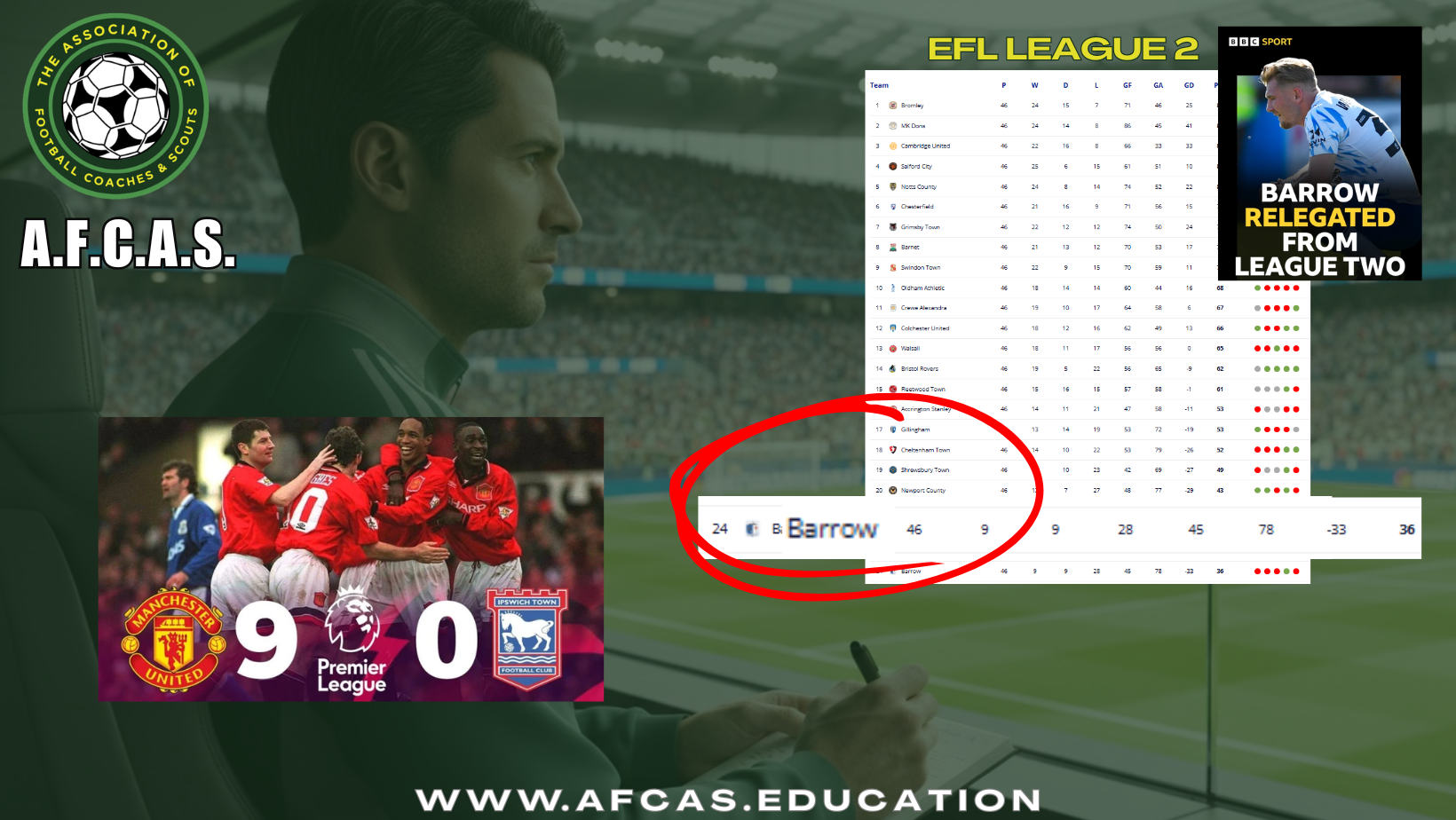
GOOD PLAYERS LOOK GREAT AGAINST POOR OPPOSITION
One of the biggest dangers in football recruitment is falling in love with performances against weaker opposition.
Football constantly reminds us that confidence changes performance.
When stronger teams dominate possession…
Players receive more time.
More space.
More passing options.
More opportunities to express themselves.
Everything appears easier.
Naturally, the numbers improve.
Pass completion rises.
Successful dribbles increase.
Forward passes become easier.
Decision-making appears quicker.
Confidence grows.
The player looks outstanding.
But another question immediately follows.
Has the player improved…
…or has the environment simply become easier?
Professional recruitment departments ask this question constantly.
Because good players should perform well against weaker opposition.
The real assessment begins when those advantages disappear.
A SIX-GOAL PERFORMANCE… BUT NOT A RECRUITMENT RECOMMENDATION
One scouting assignment has always stayed with me. While working as a scout at West Ham United, I was sent to watch an Under-21 match between Fulham and Norwich City at Fulham’s training ground. The final score was 7–1 to Fulham. The Fulham centre-forward scored six goals. From the outside, it appeared to be one of the most remarkable individual performances imaginable.
Six goals.
As a performance assessment…
Outstanding.
As a recruitment recommendation…
Not yet.
Why?
Because the context mattered.
Norwich’s side was extremely weak on the night. Several players were playing above their normal age group, and the team simply couldn’t compete with Fulham’s quality. The Fulham striker wasn’t being asked difficult questions.
He wasn’t under sustained pressure.
He wasn’t competing against defenders capable of matching him physically or technically.
There was very little genuine resistance.
The performance itself deserved recognition.
But from a recruitment perspective, it answered very few questions.
Could he reproduce that level against stronger defenders?
How would he cope when space became limited?
Could he influence a game when his team wasn’t dominating possession?
Could he still score when every opportunity had to be earned?
Those questions remained unanswered. The performance was outstanding. The evidence, however, was incomplete. Professional recruitment departments don’t recruit players because they dominate one easy match.
They continue watching until the player has been tested against opponents capable of exposing both their strengths and their weaknesses.
That is the difference between evaluating a performance…
…and making a recruitment decision.

DO PLAYERS UNDERESTIMATE THE OPPOSITION?
This is another area that often separates good scouts from outstanding recruitment departments. Sometimes the opposition isn’t stronger. Sometimes the problem is the player. Or more specifically… Their mentality.
When elite players face weaker opponents, there can be a subconscious temptation to lower their own standards. The game appears easier. Concentration drops. Decision-making becomes careless. Intensity decreases. One-versus-one duels that should be dominated suddenly become competitive. Simple passes become rushed. Players begin playing within themselves rather than imposing themselves on the game.
Professional scouts must recognise the difference.
Has the underdog genuinely raised their performance… Or has the stronger player simply allowed their own standards to fall? We see this throughout football. FA Cup shocks. League Cup upsets. International surprises.
History is full of examples where teams with greater budgets, better players and stronger squads have underestimated supposedly weaker opponents.
International football provides countless examples. The Faroe Islands have repeatedly produced shock results against nations expected to beat them comfortably.
Those results rarely happen because the smaller nation suddenly possesses superior players.
They often happen because one team raises its standards…
…while the other lowers them.
That is something professional scouts should also be assessing. When watching players against weaker opposition, ask yourself:
Do they continue to dominate?
Do they maintain the same intensity?
Do they demand the same high standards from themselves?
Or do they become complacent?
Because mentality is part of player assessment too.
The best players don’t simply raise their level for the biggest occasions. They maintain their standards regardless of who stands in front of them.
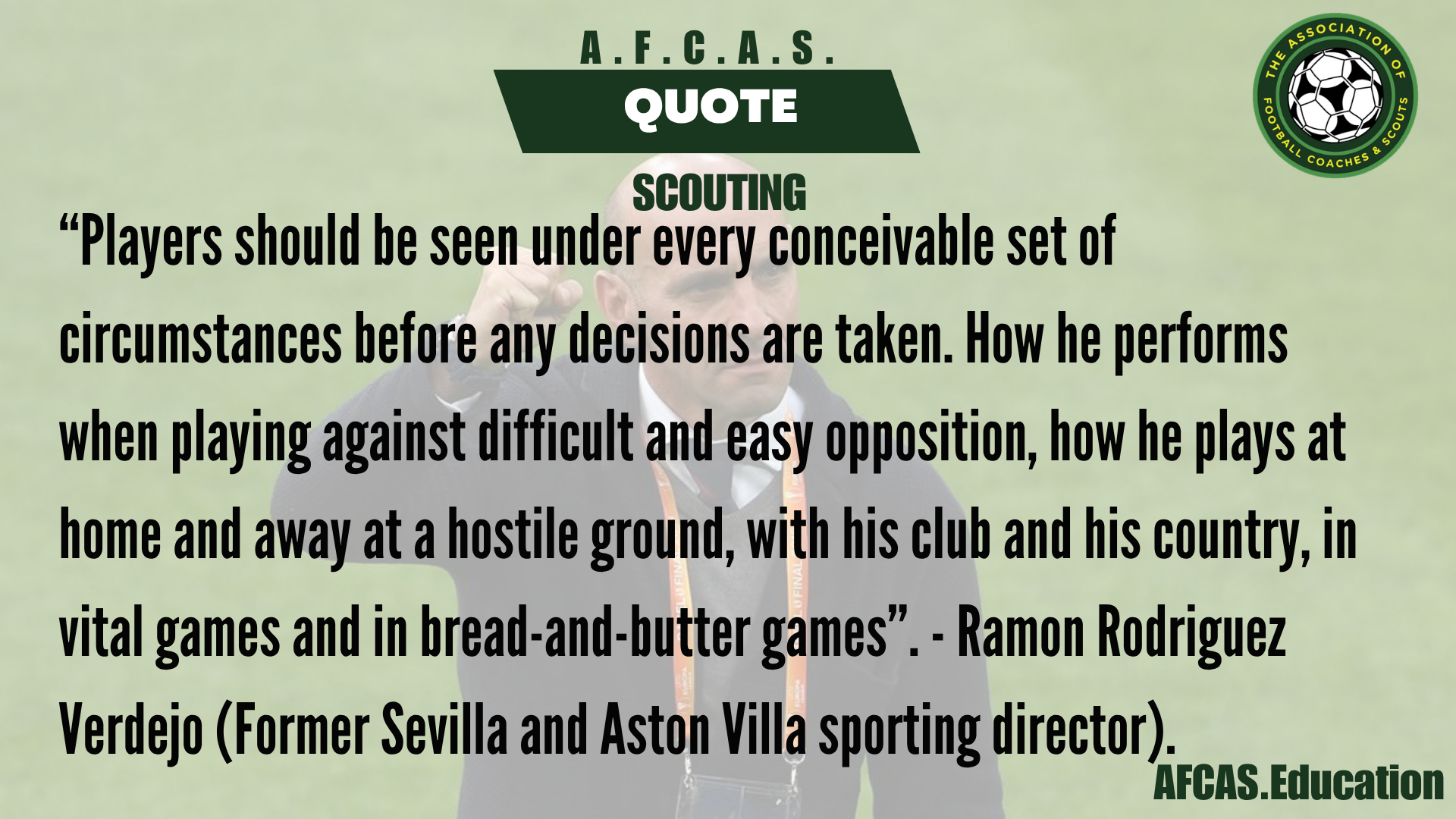
WHEN THE GAME BECOMES DIFFICULT
Watching players against weaker opposition is only one side of the recruitment picture. The real questions begin when the standard rises.
How does the player respond when time and space disappear?
Can they still execute technically under pressure?
Do they continue demanding possession?
Can they still solve problems?
Or does their performance begin to disappear?
These are often the matches that reveal the most about a player.
Professional recruitment departments pay particular attention to performances against the strongest opponents because those are often the environments the player will be entering if recruited.
A player capable of consistently competing against elite opposition is far more likely to adapt to a higher level than a player who only dominates weaker teams.
Football becomes faster.
Pressure arrives earlier.
Decisions must be made quicker.
Mistakes are punished more severely.
The player is no longer the dominant individual on the pitch.
Now they have to prove they belong.
That is where genuine quality begins to reveal itself.
ASSESSING A BOTTOM-OF-THE-LEAGUE TEAM… PLAYING AGAINST TOP-HALF OPPOSITION

Assessing players from struggling teams can sometimes feel like one of the least enjoyable assignments in football scouting.
The team is regularly losing.
Confidence is low.
Possession is limited.
The opposition dominates.
On paper, it can appear to be a wasted journey. I’ve experienced this many times throughout my own scouting career. When covering Manchester City home matches, many visiting teams arrived simply trying to survive. The game often became one-sided. Yet even during those difficult afternoons, valuable recruitment information continued to emerge.
Sometimes the player you are assessing has very little opportunity to impress technically.
Instead…
Something far more important begins to appear.
Character.
When a team is constantly defending, individual qualities become easier to isolate.
Who continues organising those around them?
Who keeps demanding the ball?
Who refuses to hide?
Who continues communicating?
Who keeps competing despite the scoreline?
Who still believes they can influence the match?
Those are often the players that remain in your notebook long after the final whistle. Professional scouts understand that context matters.
A centre-back making fifteen clearances because their team is under relentless pressure is facing a completely different challenge from one enjoying seventy percent possession.
A midfielder trying to build attacks for a struggling side may never receive the same support as one surrounded by technically superior teammates.
Judging both players by the same statistical measures would completely ignore the reality of the game.
Sometimes the player worth recruiting is playing for the weaker team. Sometimes the player producing the strongest performance is wearing the losing shirt.
Professional recruitment departments know the difference.

CHARACTER CAN OUTSHINE PERFORMANCE
One of the biggest lessons in professional football scouting is that the player with the best statistics isn’t always the player who leaves the strongest impression.
Imagine two central midfielders. One dominates during a comfortable 4–0 victory. The other plays for a struggling side that loses 3–0 against the league leaders.
Which player deserves the better report? The answer isn’t obvious. The second player may have demonstrated qualities that statistics simply cannot measure.
Still demanding possession.
Still competing.
Still communicating.
Still organising teammates.
Still looking for solutions.
Still taking responsibility.
Professional scouts notice these moments. Because recruitment isn’t simply about identifying who performs best when everything is going well. Sometimes it is about identifying the player who refuses to let standards fall when everything around them is collapsing.
These moments often reveal leadership.
Mental resilience.
Competitive mentality.
Professional pride.
They reveal the type of footballer every recruitment department wants inside the dressing room. This is why experienced scouts never become fixated on scorelines.
They understand that difficult matches often reveal far more about a player than comfortable victories ever could.
And sometimes… The player who impresses the recruitment department most is the one who has just walked off the pitch on the losing side.
That is why professional scouts never judge players by results alone.
They judge them by how they respond when the game asks its toughest questions.

GORDON STRACHAN: WHY SCOUTS MUST LOOK BEYOND THE SCORELINE
Gordon Strachan, as a player, was a serial winner in Scotland, where his club Aberdeen dominated for a number of years, before moving down to England, winning the FA Cup with Manchester United, and the League title with Leeds United! But Strachan did not start his career with a successful top-of-the-league team.
One story perfectly illustrates why professional scouts should never judge a player solely by the result.
Before Gordon Strachan signed for Aberdeen, he played for Dundee. Dundee suffered a humiliating 6–0 defeat away to Queen of the South in a League Cup tie.
On paper, it looked disastrous.
Many people would simply have looked at the scoreline and moved on.
But Billy McNeill, then manager of Aberdeen, wanted to know something far more important.
He asked Queen of the South manager Mike Jackson a simple question.
“What was Gordon Strachan like?”
Jackson’s reply wasn’t that Strachan had been the best player on the pitch.
Instead, he said:
“Not great, but unlike one or two other Dundee players, the wee man worked his socks off.”
Years later, Strachan reflected on how important that moment became in his career.
He wrote:
“I often refer to that match when talking to players about the importance of never allowing their heads to drop, and how this can provide seemingly unlikely defining moments in careers.”
He even admitted that he often wondered whether he would ever have signed for Aberdeen if Mike Jackson had instead replied:
“He looked as if he wasn’t bothered.”
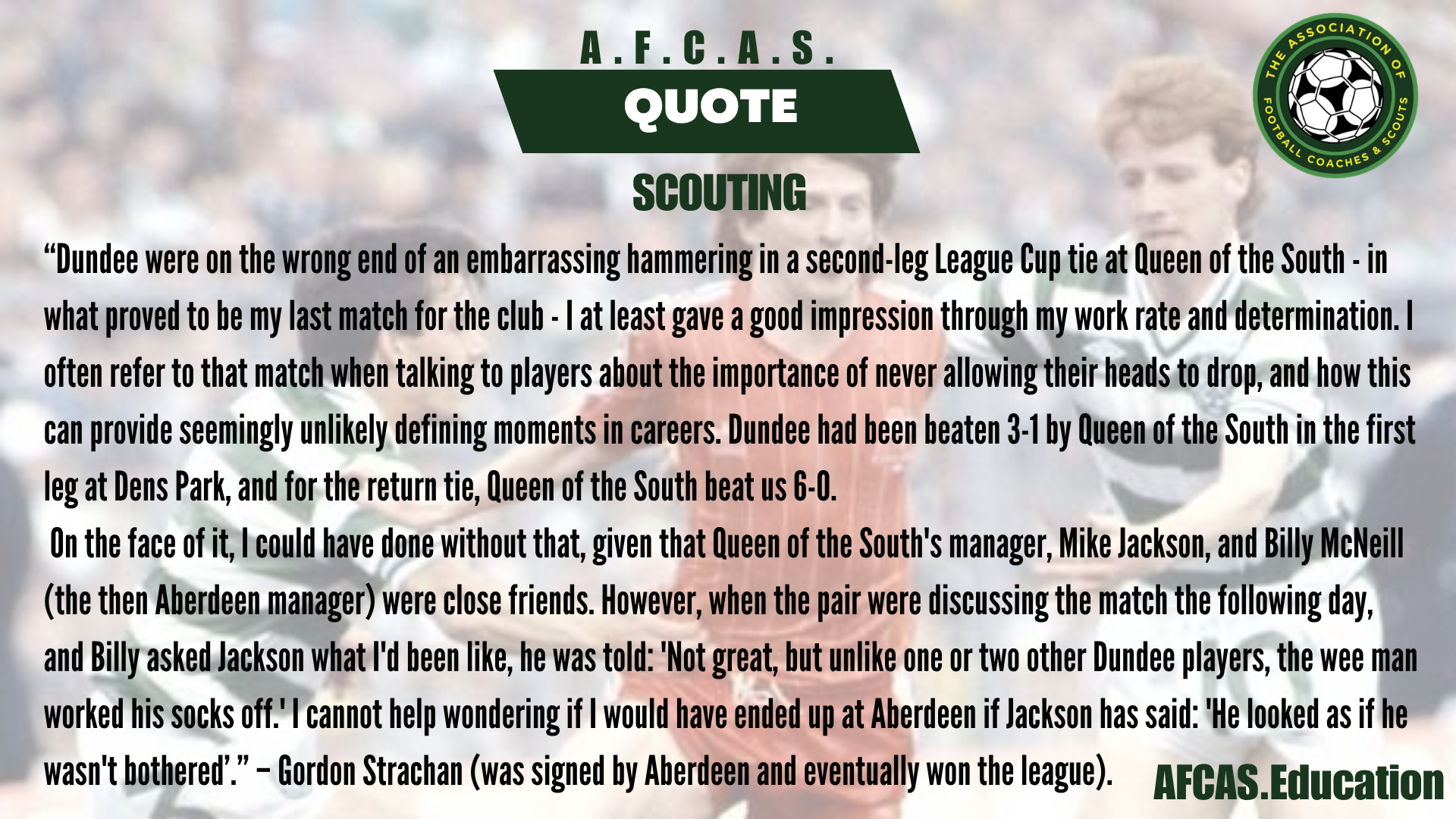
That story perfectly captures one of the most important principles in football scouting.
The scoreline didn’t earn Gordon Strachan his move.
His mentality did.
Sometimes the player worth recruiting isn’t the one celebrating at full-time.
Sometimes it’s the one who refuses to stop competing when everything around them is going wrong.
Professional scouts don’t simply assess performance.
They assess resilience.
Attitude.
Mentality.
Character.
Because those qualities often become visible when the football itself becomes difficult.
CASE STUDY
BOTTOM OF THE LEAGUE… HAMMERED EVERY WEEK… SPOTTING A WINNER
One of the most rewarding aspects of professional scouting is identifying players long before everyone else begins talking about them.
A few years ago, my colleague George Lappas and I covered the French Ligue 2 market for several seasons.
Historically, it has been one of Europe’s richest leagues for identifying emerging talent.
Players such as Riyad Mahrez and N’Golo Kanté both developed there before going on to become Premier League champions with Leicester City.
During my first season following the league, one club seemed to be on the wrong end of the result almost every week.
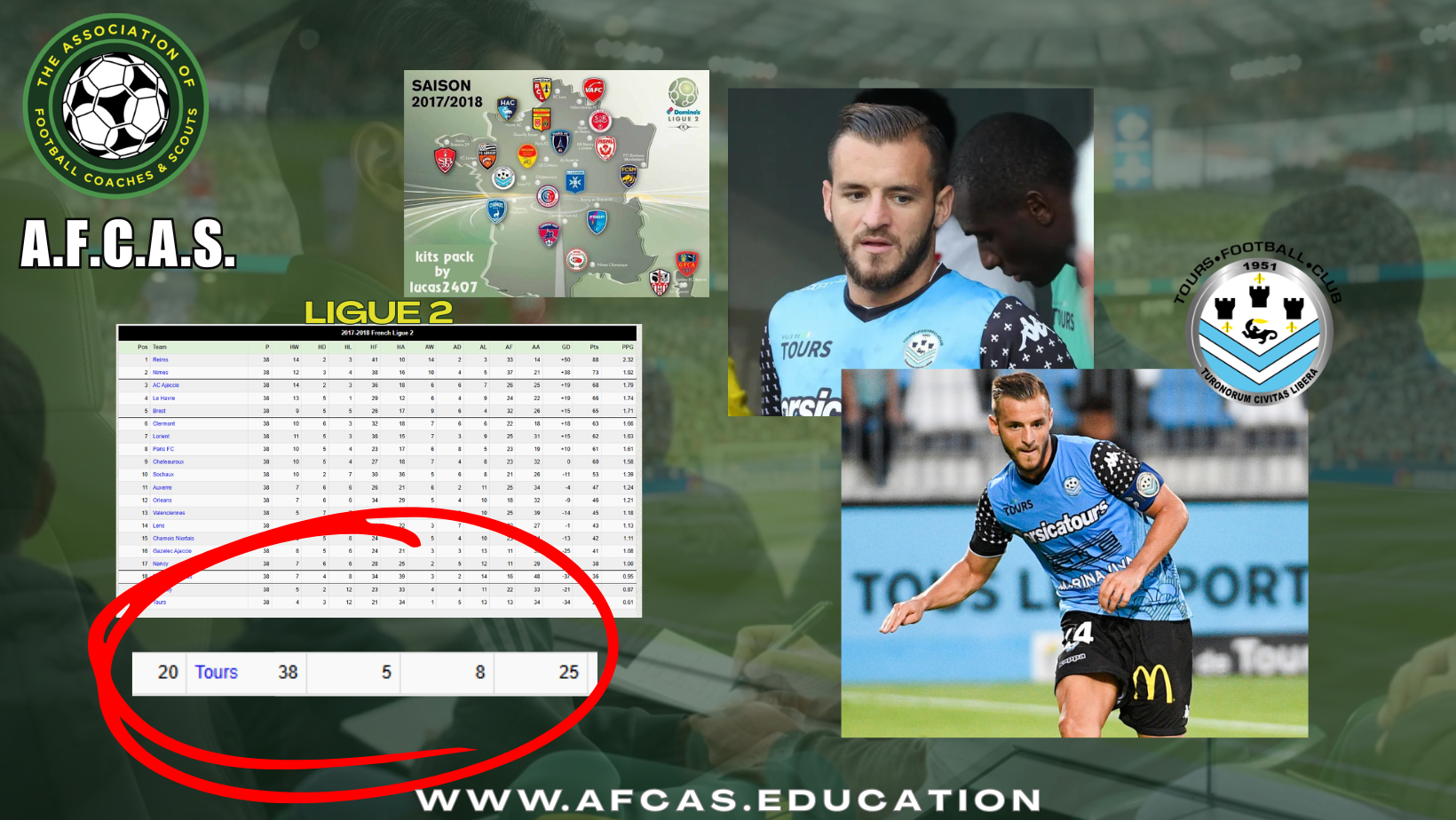
Tours FC.
They were rooted to the bottom of the table. Results were poor. The squad lacked quality. The pitch was in poor condition. The stadium itself looked tired. Even the team’s kit somehow reflected the difficult circumstances surrounding the club.
On paper…
There appeared to be very little worth scouting. But professional scouts don’t stop watching simply because a team keeps losing. Because hidden inside struggling teams are sometimes outstanding individuals. Week after week one player kept appearing in my notes.
A 5ft 11in central defender named Jonathan Gradit. Tours continued losing. Yet Gradit continued competing. He never hid. He never gave up. The more I watched him, the more one quality stood above everything else. His character.
Despite constant pressure, he continued defending aggressively. He marked tightly. He anticipated danger. He intercepted. He blocked shots. He put his body on the line. When opportunities arose, he wasn’t content simply clearing the ball. He wanted to carry it forward and start attacks himself. The difficult environment wasn’t exposing weakness. It was revealing strength.
The more evidence we collected, the stronger the recommendation became.
We even spoke with his representatives, who themselves didn’t appear to realise just how much potential they had on their books. Gradit eventually earned a move to Caen in Ligue 1. Initially, opportunities were limited. Many players would have become discouraged. Instead, another move followed. This time to RC Lens. There, everything changed. Lens provided the right environment.
His leadership. His bravery. His aggressive defending. His willingness to carry the ball forward. The supporters loved him. Lens secured promotion to Ligue 1. They didn’t stop there.

Within a few seasons they finished second in France and qualified for the UEFA Champions League.
The same player who had once been battling every week at the bottom of Ligue 2 was now playing against Europe’s elite clubs.
What was the first quality that caught our attention?
Not statistics.
Not trophies.
Not headlines.
Character.
Had we judged Jonathan Gradit solely by Tours’ league position or weekly results, he might easily have been overlooked. Instead, the context of those performances revealed exactly the type of player he really was.
Professional scouting isn’t always about identifying the best player in the best team. Sometimes it’s about recognising outstanding qualities hidden inside difficult environments. Because football has a habit of disguising exceptional players inside struggling teams.
The recruitment department’s job is to recognise them before everybody else does.
THE DANGER OF STATISTICS WITHOUT CONTEXT
Performance data has transformed modern football recruitment.
It identifies trends. It highlights strengths. It raises important questions. But statistics should never be viewed in isolation. Every number requires context.
A striker scores twenty-five league goals.
Against who?
A defender wins eighty percent of their aerial duels.
Against what calibre of forwards?
A midfielder completes ninety-two percent of their passes.
Where on the pitch?
Against which opponents?
Was the team dominating possession?
Or defending for most of the game?
The statistic itself rarely tells the whole story.
Professional scouts understand that data answers one question:
What happened?
Scouting then answers the next:
Why did it happen?
The best recruitment departments never allow data to replace observation. Instead, they allow the two to work together.
Data identifies patterns.
Scouting explains them.
That combination reduces recruitment risk.

WHAT RECRUITMENT DEPARTMENTS REALLY WANT TO KNOW
Rather than simply asking:
“Did the player play well?”
Professional recruitment departments ask much deeper questions.
Did they perform against elite opponents?
Did they maintain their standards under pressure?
Did they continue demanding possession?
Did they solve difficult problems?
Did they influence the game despite stronger opposition?
Did they continue competing when their own team struggled?
Did they make those around them better?
These are the questions that separate professional recruitment from simple player observation.
Every answer adds another layer to the evidence.
Every report moves the recruitment department closer to understanding the player.
BUILDING EVIDENCE OVER TIME
One match proves very little. Five matches begin to establish patterns. Twenty matches begin to build evidence. That is why professional recruitment departments rarely become excited by isolated performances.
Instead, they continue asking:
Is this performance typical?
Has the player produced this level before?
Can they reproduce it against stronger opponents?
Will these qualities transfer to our environment?
Every observation either strengthens the evidence…
…or weakens it.
The objective is never to confirm an opinion. It is to discover the truth. Professional scouting requires patience. It requires discipline. Most importantly, it requires the willingness to change an opinion when new evidence emerges.
The best scouts don’t become attached to their first report.
They continue collecting evidence until the complete picture becomes clear.

DIFFERENT OPPOSITION REVEALS DIFFERENT PLAYERS
Throughout every season…
Players face different tactical systems.
Different formations.
Different playing styles.
Different physical demands.
Different technical standards.
Different levels of pressure.
Every opponent asks different questions.
Every performance provides different answers.
Some players dominate weaker opposition.
Others come alive only when facing elite players.
Some maintain remarkable consistency regardless of the challenge.
Those are often the footballers recruitment departments value most. Professional scouting is about collecting those answers over time. Because every new opponent reveals another layer of the player.
FINAL THOUGHTS
The easiest matches rarely reveal the most.
Comfortable victories can disguise weaknesses.
Heavy defeats can reveal strengths.
Outstanding performances can become misleading when viewed without context.
Average performances can become extremely impressive once the quality of the opposition is understood.
That is why professional recruitment departments never judge performances in isolation. They judge them within the environment in which they occurred.
Every opponent changes the challenge.
Every opponent changes the context.
Every opponent reveals something different about the player.
Professional football scouting isn’t about finding players who dominate weaker opposition.
It’s about identifying players whose qualities remain visible…
…when the opposition becomes stronger.
Because successful recruitment should never be based simply upon impressive performances.
It should be based upon understanding who those performances came against.
As Brian Clough reminded us decades ago:
“You deal in hard facts and you must never back hunches.”
Watching players against different levels of opposition is one of the ways professional scouts turn opinions into evidence.
And evidence…
…is what successful recruitment is built upon.
CONTINUE READING THE AFCAS SCOUTING METHODOLOGY
This article forms part of the AFCAS Scouting Methodology series.
Continue your learning with:
✅ Continue Reading – The Content of Scouting: Part 1 – Professional Football Scouting: Why Context is Everything When Assessing Players
✅ Continue Reading – The Content of Scouting: Part 2 – Watch the Player Under Different Spotlights… And in Daylight
✅ Continue Reading – The Content of Scouting: Part 3 – Home, Away, and Hostile
✅ Continue Reading – The Content of Scouting: Part 4 – Assessing Players Against Different Levels of Opposition
📖 Continue Reading – The Content of Scouting: Part 5 –
Each article explores another layer of the professional scouting process, demonstrating how recruitment departments reduce risk by building evidence through context rather than relying on isolated performances or statistics alone.
📖 Continue Reading – Football Scouts – Assessing Leadership in Football: More Than an Armband
📖 Continue Reading – Football Scouting: A Beginner’s Guide to Football Scouting
📖 Continue Reading – Football Scouting Courses: What should you expect from a Scout Education Provider
📖 Continue Reading – Football Scouting: How to Target the Right Club and Making the Perfect First Impression

Take your Football Scouting ability to the next level with AFCAS Interactive Football Scouting Education.
🎓 Continue Your Scouting Education –
🧠 Every Great Scout Starts By Learning…
…but progresses through practical experience.
The AFCAS 4-Course Football Scouting Bundle combines professional knowledge with interactive practical exercises to help you develop the skills used within professional football.
📦 Complete 4-Course Bundle
🎓 Interactive Learning
⚽ Practical Player Assessments
📜 Certificates Included
👉 Enroll Now

AFCAS STUDENTS
Our students have joined AFCAS from, or progressed to opportunities with, some of the world’s leading football clubs and associations, including:
National Football Associations
Dutch FA • English FA • Nigerian FA • Belgian FA
Professional Clubs
Arsenal • Manchester City • Chelsea • Manchester United • Newcastle United • Brighton & Hove Albion • West Ham United • Crystal Palace
Burnley • Ipswich Town • Leeds United • Millwall • Charlton Athletic • Queens Park Rangers • Cardiff City • Swansea City
Middlesbrough • Norwich City • Blackburn Rovers • Fleetwood Town • Luton Town • Lincoln City • AFC Wimbledon • Doncaster Rovers
FC Porto • AZ Alkmaar • PSV Eindhoven • Inter Miami • LA Galaxy • Rangers • Heart of Midlothian • Paris FC
…and many more.


🎓 Start Your Football Scouting Journey
Take the first step towards becoming a better football scout with the AFCAS Football Fundamentals & Talent ID Course – Level 1.
Designed for aspiring scouts, coaches, analysts and football enthusiasts who want to learn how professional scouts identify and assess players.
✅ What’s Included
✅ 70+ Interactive Video Learning Tasks
✅ Practical Player Assessment Exercises
✅ Professional Scouting Methodology
✅ Learn from Premier League, EFL & International Scouting Experience
✅ Study at Your Own Pace
📜 Certificate Awarded Upon Completion
👉 Enroll Today


Originally published by AFCAS – Association of Football Coaches and Scouts
The coaching frameworks, scouting methodologies, player assessment models and educational content contained within the AFCAS Education Hub have been developed from the practical experiences of AFCAS educators working within grassroots, academy, professional and international football.
Original AFCAS Educational Content
The educational content, coaching principles, scouting methodologies and practical frameworks published within the AFCAS Education Hub have been developed through years of professional coaching, scouting and recruitment experience.
These articles represent original AFCAS educational material and are protected by copyright. Any reproduction, adaptation or commercial use without written permission is prohibited.
Please support original football education by sharing links to the original AFCAS articles rather than reproducing their content.
© AFCAS. All Rights Reserved.
About the Author
Ged Searson is the Managing Director of AFCAS and has over 30 years of coaching and scouting experience. He is a former Premier League First Team Scout, former EFL scout and former Chief Scout of the Malawi National Team. Through AFCAS, he has educated coaches and scouts from across the UK and around the world.
Published: 30 June 2026
Author: Ged Searson
Updated: 30 June 2026