THE SPOTLIGHT
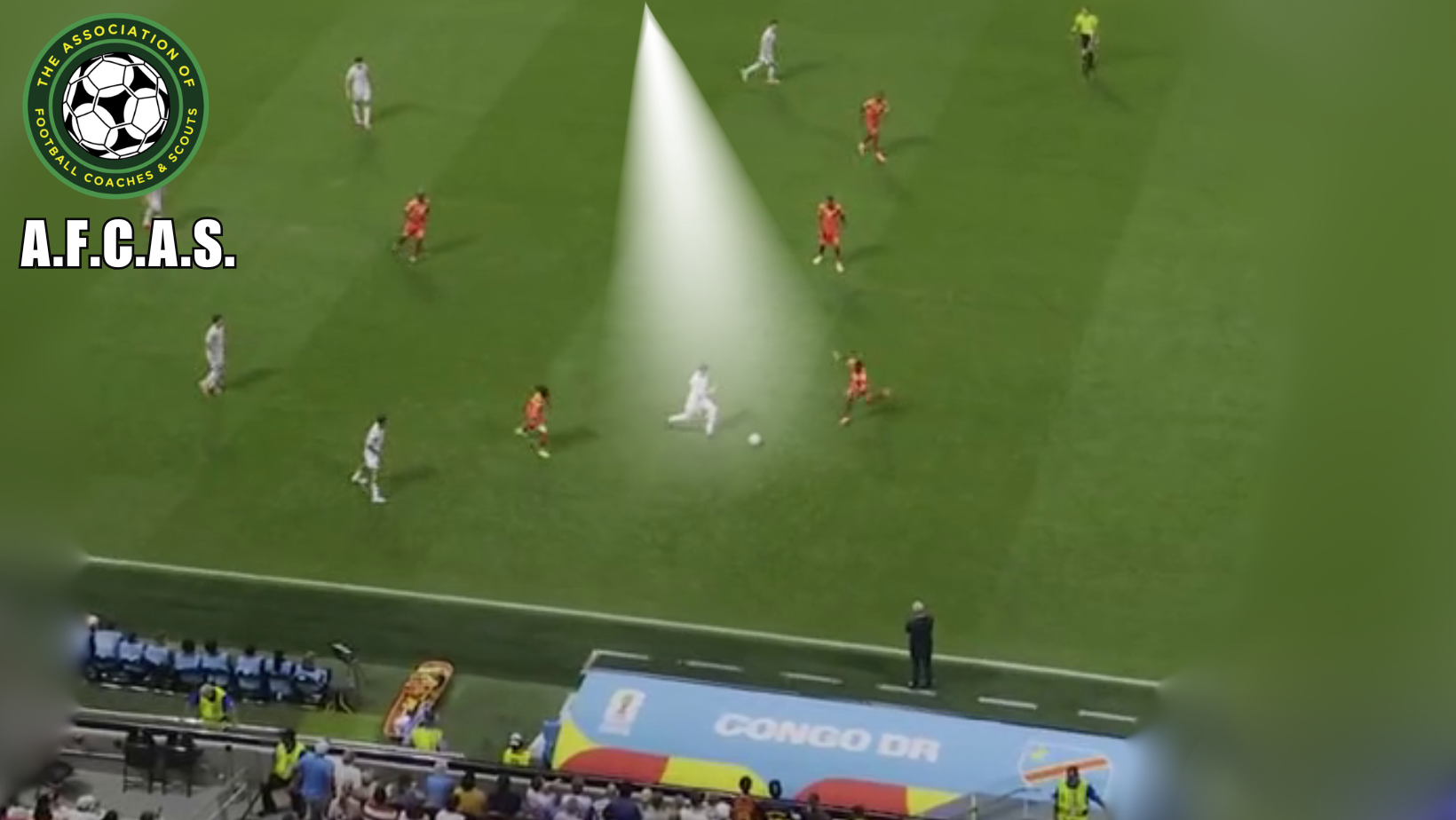
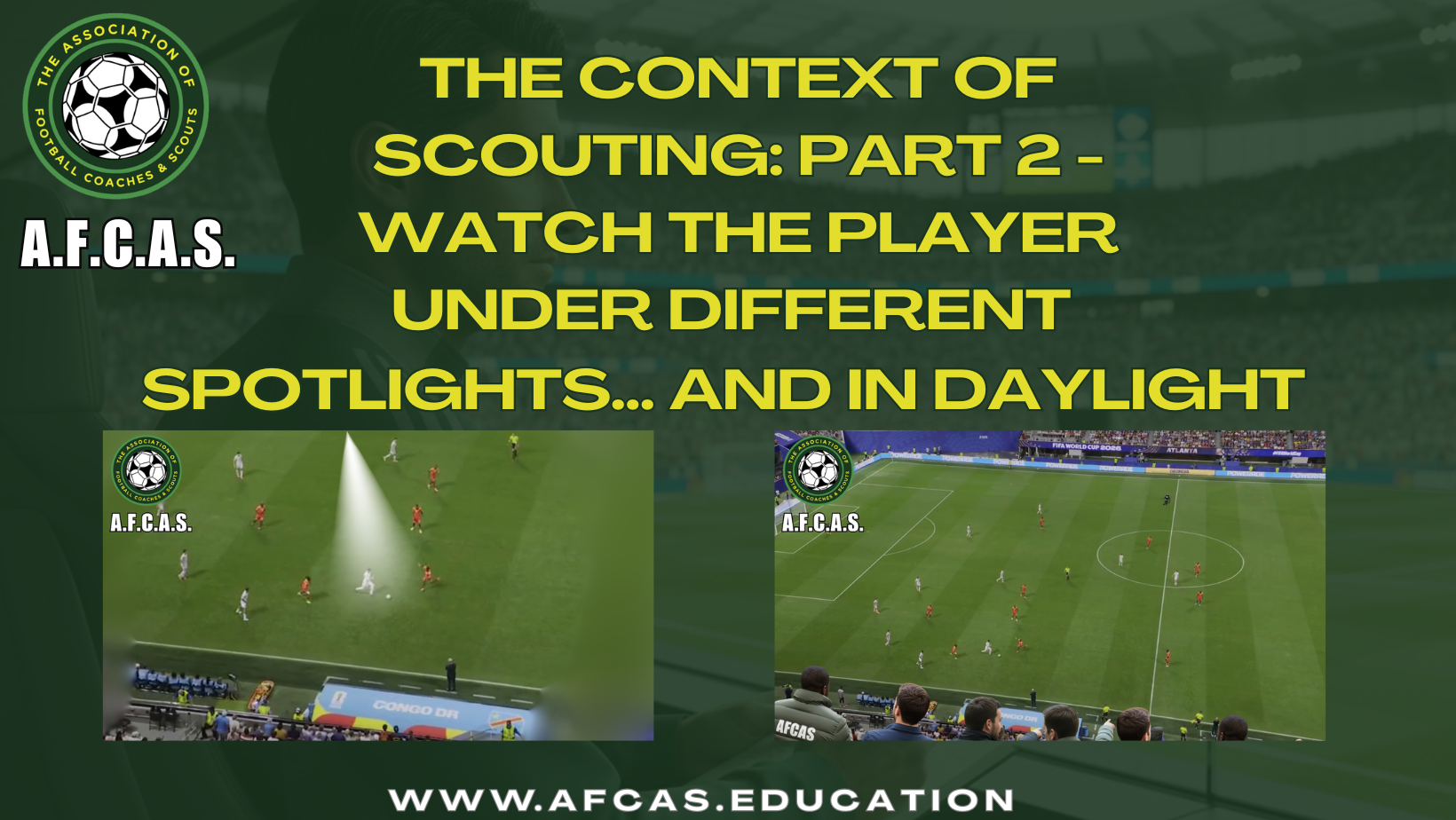
Think of video scouting as watching a player under a spotlight.
The camera directs your attention.
It highlights the player.
It follows the ball.
It captures the major incidents.
- Goals.
- Assists.
- Tackles.
- Mistakes.
- Moments.
For analysing technical actions, video is exceptional.
It allows scouts to:
- Watch matches repeatedly.
- Slow footage down.
- Review decisions.
- Compare performances.
- Analyse technical execution.
- Observe tactical patterns.
Modern recruitment departments couldn’t operate without it, particularly when assessing players from different countries and competitions.
However, there is one important limitation.
The camera only shows what the camera chooses to show.
Even when full-match footage is available, true wide-angle coverage is often limited, meaning significant off-the-ball actions, movements and behaviours can easily be missed. It is impossible to ass the player in ‘The Nine areas of Player Possession!’
…The Spotlight…

THE SAME MATCH… TWO COMPLETELY DIFFERENT ASSESSMENTS
One of the biggest misconceptions in modern scouting is that watching a match live and watching exactly the same match on video will produce the same assessment.
It won’t.
Both methods allow you to assess the same player in the same game, but they provide two completely different perspectives.
Video allows the scout to pause, rewind and replay incidents repeatedly. Technical actions on the ball, decision-making in possession, passing technique and defensive actions around the ball can all be analysed in greater detail than during live observation.
Live scouting, however, provides something that video rarely can. Context.
Live scouting allows you to assess communication, scanning, movement, body shape, leadership, reactions, relationships with teammates and the player’s contribution away from the ball—qualities that often influence the next phase of play but are frequently outside the camera’s view.
The reality is that the same ninety minutes can produce two entirely different scouting reports.
Neither is wrong.
They simply answer different questions.
The strongest recruitment departments understand this and combine both methods to build the most complete picture of the player.
THE DAYLIGHT
Live scouting provides something entirely different.
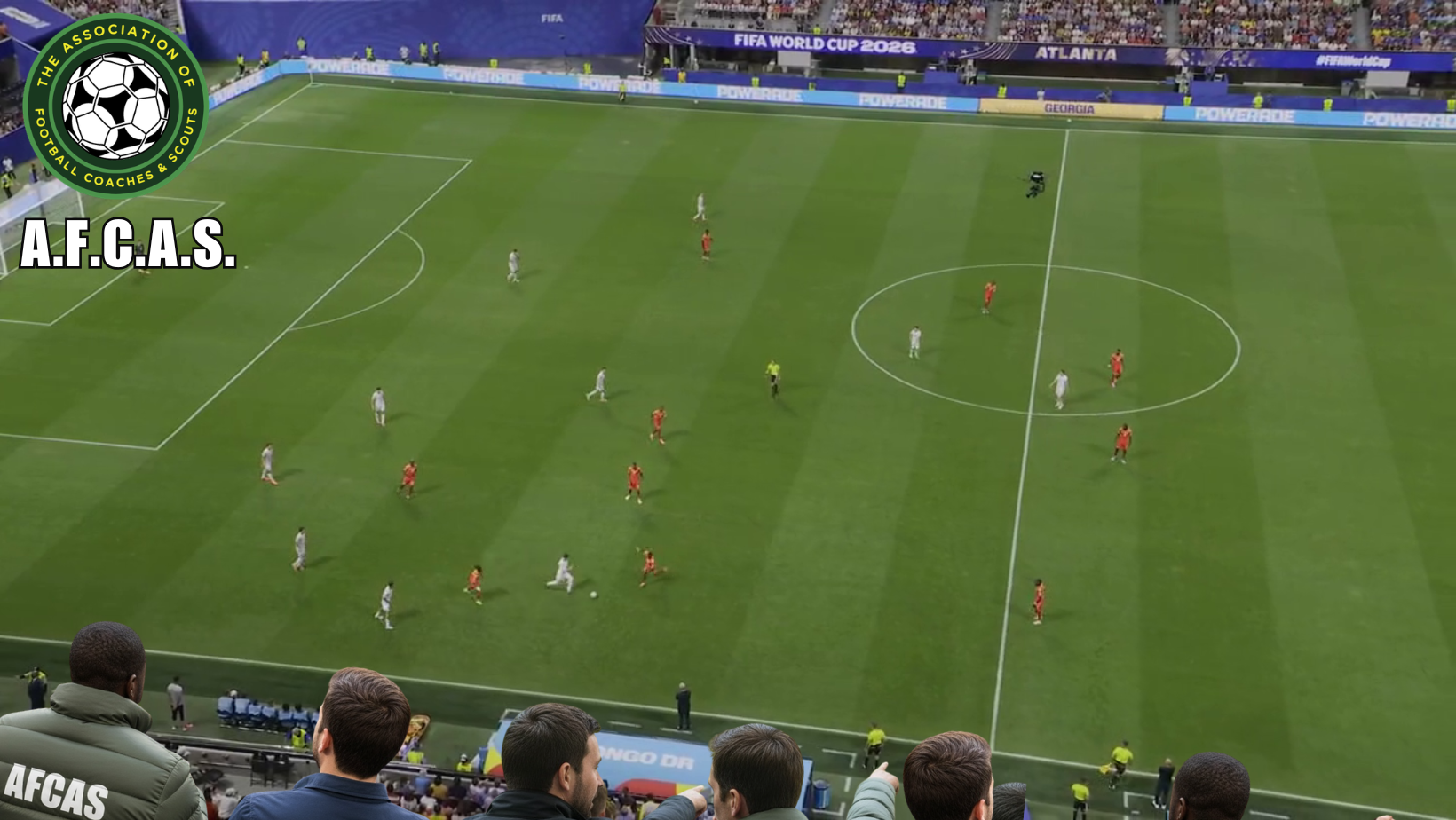
Imagine stepping away from the spotlight.
Suddenly, the whole pitch becomes visible.
Instead of watching only the player with the ball, you begin watching everything happening around them.
Only by watching the player away from the ball can you truly assess their performance within the AFCAS Nine Areas of Player Possession.
You need to ask yourself:
- Are they switched on and alert away from the ball?
- How often do they scan?
- Do they constantly check their shoulders before the next phase of play?
- How do they communicate?
- How do teammates react to them?
- How do they organise those around them?
- Defensively, are they alert and switched on, or do they become ball watchers?
- How do they react when a teammate loses possession?
- How do they react when possession is regained?
- Can they create space around the ball?
- Can they find space away from the ball?
Professional football isn’t played only when players touch the ball.
Most of their decisions happen before they ever receive possession.
These are often the moments that television cameras never capture.
… The Daylight…
FOOTBALL IS MOSTLY PLAYED WITHOUT THE BALL
One of the biggest mistakes inexperienced scouts make is becoming “ball watchers.”
Every spectator naturally follows the football.
Professional scouts mustn’t.
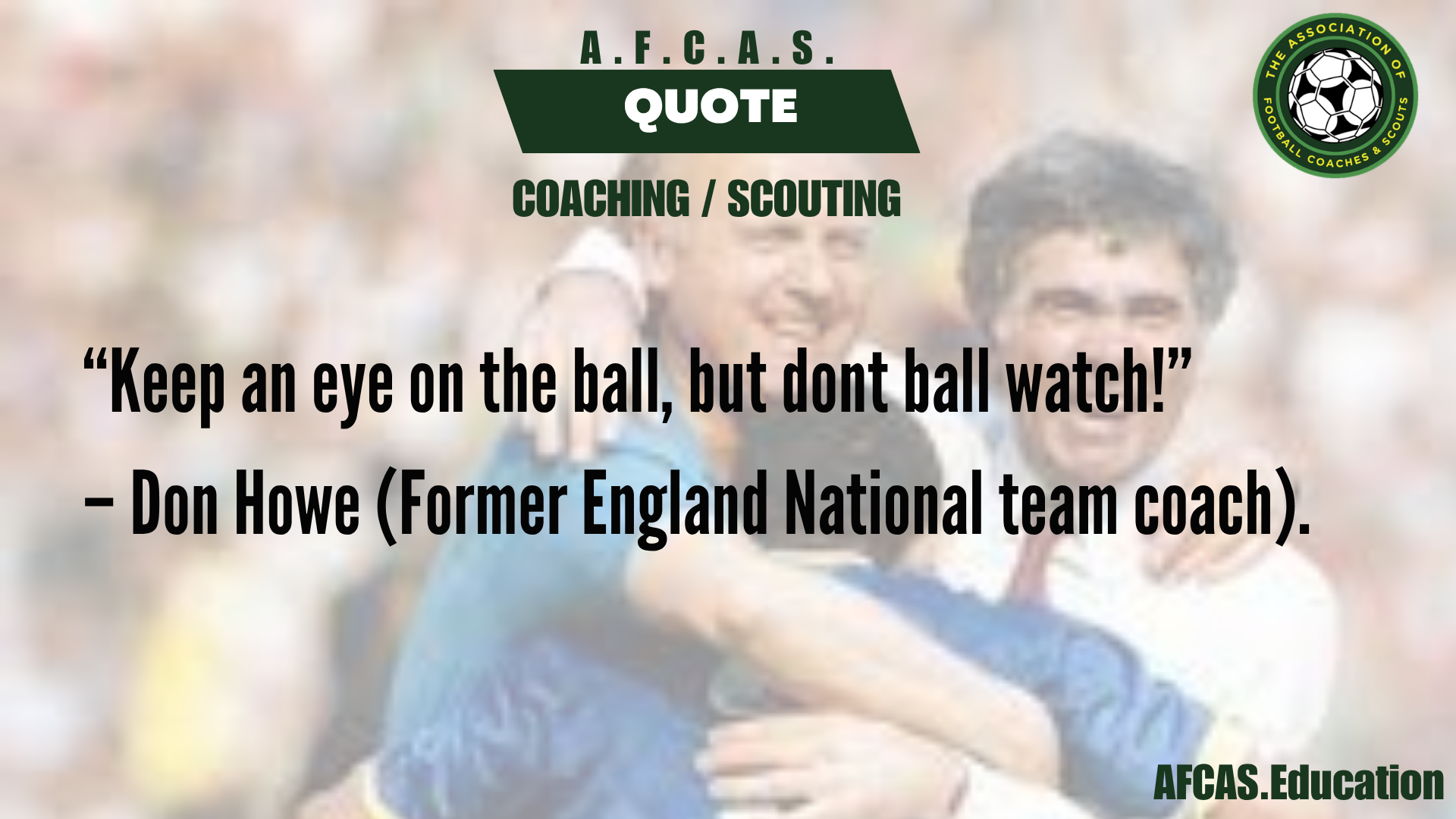
I once attended a coaching seminar delivered by former England coach Don Howe, where he made a statement that has stayed with me ever since:
“Keep an eye on the ball, but don’t ball watch.”
Although originally a coaching principle, it applies equally to football scouting.
Professional scouts don’t simply watch where the ball is.
They watch where the game is about to go.
There are moments during a match when the ball is actually the least interesting thing happening on the pitch.
While supporters watch the pass, the professional scout may be watching the striker’s movement, the centre-back’s communication, the goalkeeper’s positioning or the midfielder’s scanning.
Football is a game of continuous movement, not isolated moments.
The ball simply connects those moments together.
Instead, you should observe:
- Movement before receiving.
- Supporting angles.
- Communication.
- Scanning.
- Defensive positioning.
- Recovery runs.
- Leadership.
- Body language.
- Reactions.
- Decision-making.
Many of the qualities that separate elite players from good players occur long before they become involved in play.
If the camera doesn’t show those actions, they simply cannot be assessed.
HOW COVID CHANGED FOOTBALL SCOUTING
Before the COVID-19 pandemic, many recruitment departments viewed video scouting as a secondary tool. Live observation remained the gold standard.
Then travel restrictions changed football almost overnight.
Scouts couldn’t travel.
Clubs had no choice.
Video scouting suddenly became the primary method of assessing players, and platforms such as Wyscout became invaluable.
Video scouting itself didn’t suddenly become better overnight.
What changed was the willingness of clubs to trust it more, while owners quickly recognised the significant financial savings it could bring.
No more paying 45p mileage for multiple scouts every weekend.
No more regular flights across Europe with overnight stays.
The recruitment net suddenly became global.
Players could now be identified from almost anywhere in the world, dramatically increasing the reach of recruitment departments.
However…
One important challenge remained.
Video could never completely replace live observation.
BEWARE… HIGHLIGHT VIDEOS
Perhaps the greatest danger of modern scouting is the highlight reel.
Every player looks outstanding in a three-minute compilation.
Goals.
Skills.
Long passes.
Tackles.
Celebrations.
Personally, I have always refused to assess players from highlight reels. They are designed to sell the player, not to evaluate the player.
What highlight videos rarely show are:
- Poor decisions.
- Missed runs.
- Lack of communication.
- Defensive mistakes.
- Lack of recovery runs.
- Poor positioning.
- Losing concentration.
- Body language after setbacks.
Highlights remove context.
Professional recruitment departments recruit players based upon complete performances, not edited moments.
If using video, always watch full matches. Never judge a player solely from a highlight package.
If a player is recommended by a trusted source, often an agent, and accompanied by a highlight video, a good recruitment department should already have its own observations and reports on that player. If the player is completely unknown, begin your own assessment process from scratch.
Never allow an edited video to form your first opinion.
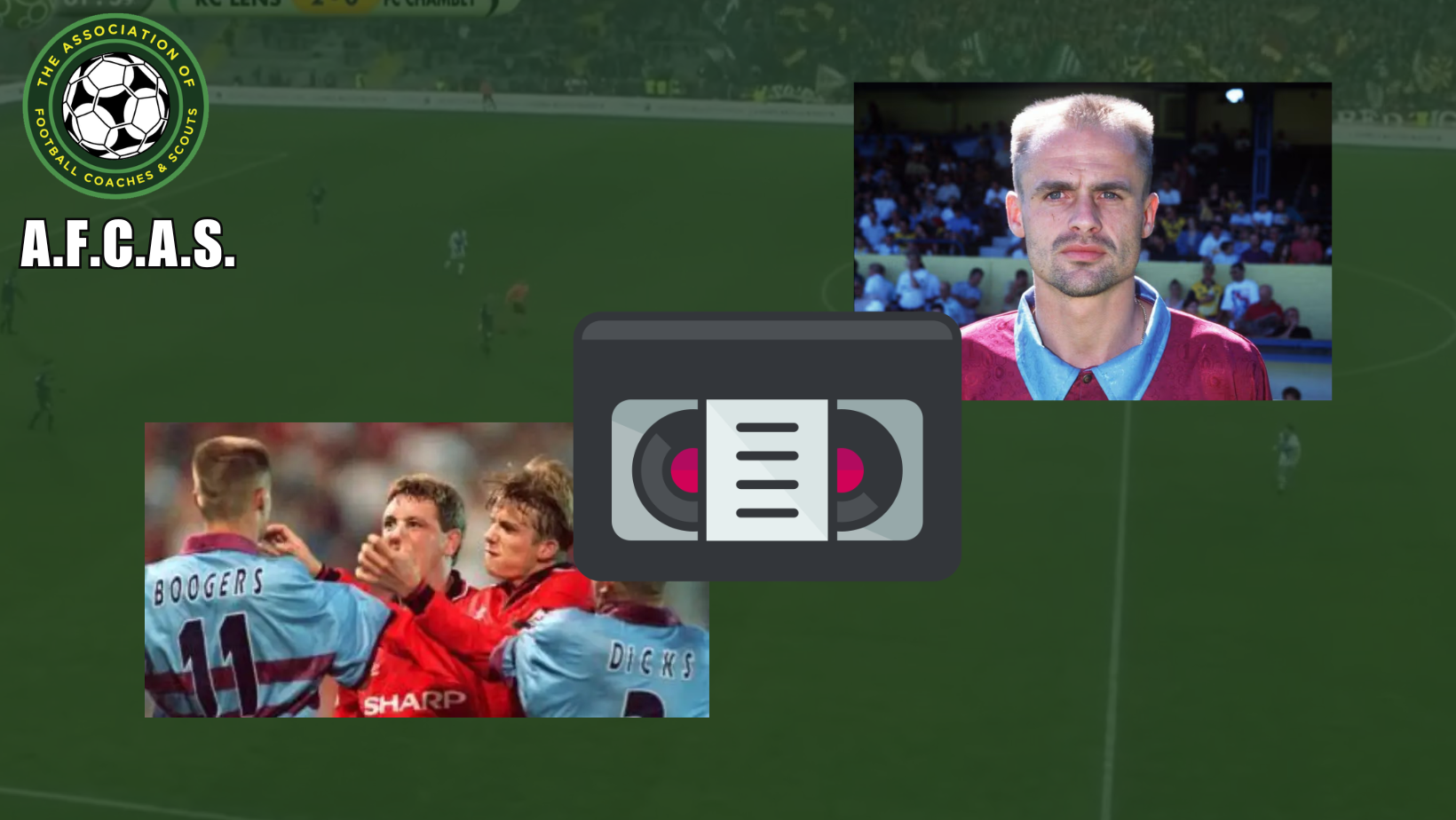
Marco Boogers was signed by West Ham United from video footage…
A well-known example often discussed within football is the signing of Marco Boogers by West Ham United. The attacker came on as a sub vs Manchester United for his debut, and was instantly sent off, and never really featured again! The player was reportedly identified primarily through video footage before arriving in English football. Whether every detail of that story has grown over time or not, it has become a reminder within football recruitment of the dangers of making decisions without building enough live evidence. One observation, one video, or one highlight package should never replace a thorough recruitment process.
SEEING WHAT THE CAMERA MISSES
One of the greatest advantages of live scouting is freedom. You decide where to look. Not the television director.
Sometimes the most valuable observations occur thirty yards away from the ball.
How does the centre-back organise the defensive line?
What body shape do they adopt?
How quickly do they recognise danger?
Does the striker continue making intelligent runs even when ignored?
Does the midfielder constantly scan before receiving?
What is the goalkeeper’s starting position?
How vocal is the goalkeeper?
How does the player react after a teammate loses possession?
How do teammates respond to them?
These observations provide valuable insight into personality, leadership and football intelligence. They often influence recruitment decisions just as much as technical ability.
VIDEO GIVES QUANTITY. LIVE GIVES CONTEXT.
One major strength of video scouting is volume. A player can be watched 30, 40 or even 50 times throughout a season.
Different competitions.
Different opponents.
Different tactical systems.
That simply isn’t possible through live observation alone.
However…
Watching fifty matches on video still won’t tell you everything.
Live scouting provides context.
- Weather.
- Crowd atmosphere.
- Communication.
- Body language.
- Relationships between teammates.
- Environmental pressures.
These factors often explain performances far better than statistics or video clips alone.

THE BEST RECRUITMENT DEPARTMENTS USE BOTH
The question should never be:
“Live scouting or video scouting?”
The better question is:
“How do we combine both?”
Although every recruitment department has its own process, many now follow a structure similar to this:
Initial Identification
↓
Video Assessment
↓
Further Video Analysis
↓
Live Observations
↓
Multiple Reports
↓
Recruitment Discussion
↓
Recruitment Decision
Each stage either strengthens or weakens the evidence. The objective is never to prove yourself right.
It is to discover the truth about the player.

RECRUITMENT IS ABOUT EVIDENCE
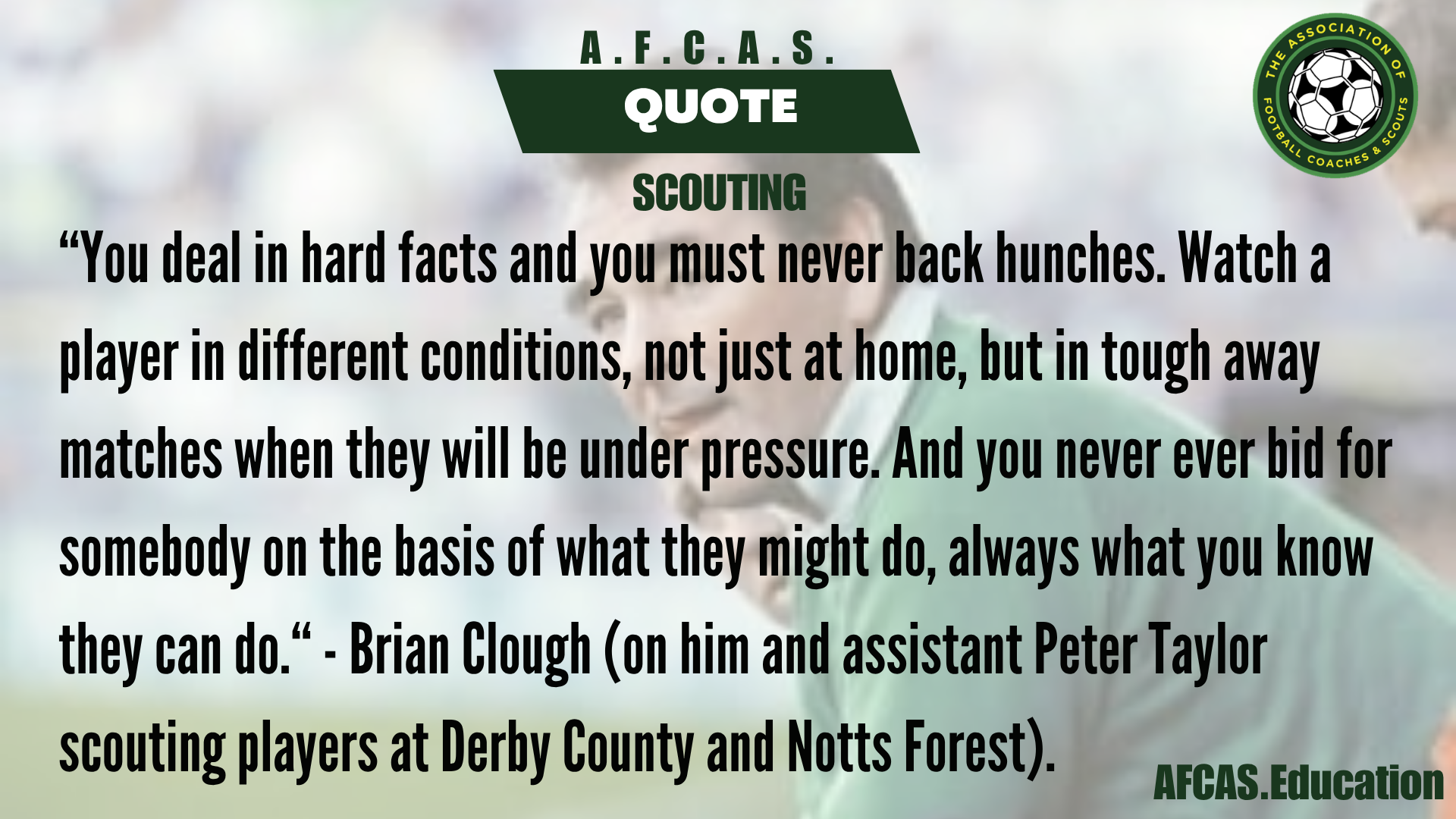
Brian Clough’s words remain timeless. Recruitment should never be based upon hunches, nor should it be based upon one outstanding performance. Or one impressive highlight reel.
Professional football scouting is about collecting evidence.
Every live observation.
Every video.
Every report.
Every discussion.
Adds another piece to the recruitment picture.
Only when those observations consistently point in the same direction should a club seriously consider investing millions of pounds in a player.
Because the best recruitment decisions aren’t built under one spotlight.
They’re built by seeing the player clearly…
…under every spotlight.
…and in daylight.
CONTINUE READING THE AFCAS SCOUTING METHODOLOGY
This article forms part of the AFCAS Scouting Methodology series.
Continue your learning with:
- Professional Football Scouting: Why Context Is Everything When Assessing Players
- Home, Away and Hostile – Why Scouts Must Assess Players in Different Environments
- Assessing Players Against Different Levels of Opposition
- Data Doesn’t Scout Players – Why the Eye Test Still Matters

Take your Football Scouting ability to the next level with AFCAS Interactive Football Scouting Education.
AFCAS – FOOTBALL FUNDAMENTALS & TALENT ID PROGRAM – LEVEL 1, LEVEL 2, and LEVEL 3 COURSES – SPECIAL OFFER – Click here for our AFCAS – INTERACTIVE TECHNICAL SCOUTING PROGRAM
AFCAS STUDENTS
Our students have joined AFCAS from, or progressed to opportunities with, some of the world’s leading football clubs and associations, including:
National Football Associations
Dutch FA • English FA • Nigerian FA • Belgian FA
Professional Clubs
Arsenal • Manchester City • Chelsea • Manchester United • Newcastle United • Brighton & Hove Albion • West Ham United • Crystal Palace
Burnley • Ipswich Town • Leeds United • Millwall • Charlton Athletic • Queens Park Rangers • Cardiff City • Swansea City
Middlesbrough • Norwich City • Blackburn Rovers • Fleetwood Town • Luton Town • Lincoln City • AFC Wimbledon • Doncaster Rovers
FC Porto • AZ Alkmaar • PSV Eindhoven • Inter Miami • LA Galaxy • Rangers • Heart of Midlothian • Paris FC
…and many more.
Start your AFCAS – Scouting Journey today – Click here

Originally published by AFCAS – Association of Football Coaches and Scouts
The coaching frameworks, scouting methodologies, player assessment models and educational content contained within the AFCAS Education Hub have been developed from the practical experiences of AFCAS educators working within grassroots, academy, professional and international football.
Original AFCAS Educational Content
The educational content, coaching principles, scouting methodologies and practical frameworks published within the AFCAS Education Hub have been developed through years of professional coaching, scouting and recruitment experience.
These articles represent original AFCAS educational material and are protected by copyright. Any reproduction, adaptation or commercial use without written permission is prohibited.
Please support original football education by sharing links to the original AFCAS articles rather than reproducing their content.
© AFCAS. All Rights Reserved.
About the Author
Ged Searson is the Managing Director of AFCAS and has over 30 years of coaching and scouting experience. He is a former Premier League First Team Scout, former EFL scout and former Chief Scout of the Malawi National Team. Through AFCAS, he has educated coaches and scouts from across the UK and around the world.
Published: 29 June 2026
Author: Ged Searson
Updated: 29 June 2026

 THE CONTEXT OF SCOUTING: PART 2