
SCOUTING – BEGINNER’S GUIDE TO FOOTBALL SCOUTING
- 25 June 2026
- Ged Searson
- 7
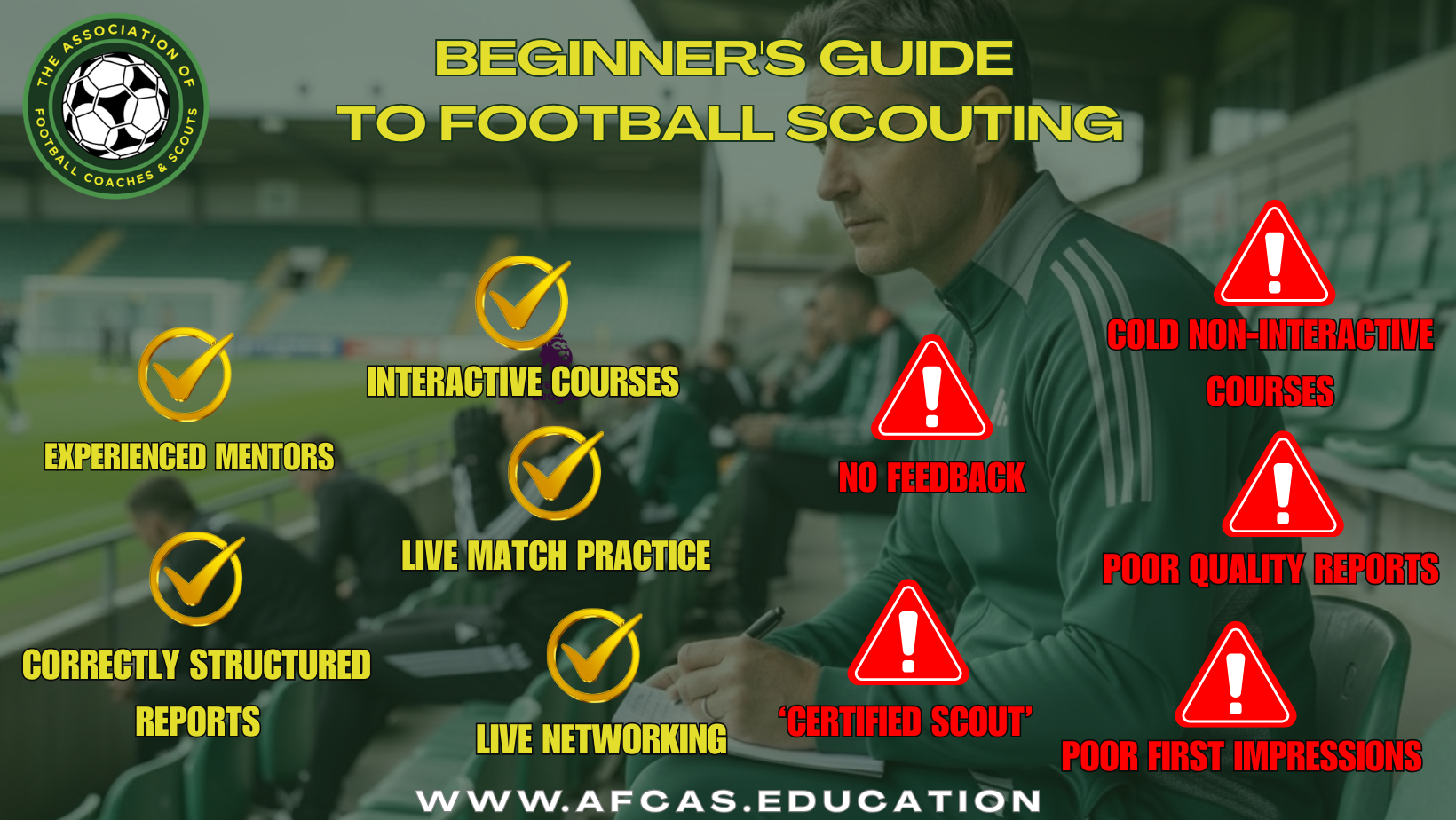

BEGINNER’S GUIDE TO FOOTBALL SCOUTING

LEARN HOW TO SCOUT & BUILD THE RIGHT FOUNDATIONS.
Football scouting is one of the most rewarding roles within the professional game. Every player identified, every report written, and every recommendation made has the potential to influence the future of a football club.
The good news is that anyone can begin their journey as a football scout.
You do not have to be a former professional footballer or an experienced coach. While those backgrounds can certainly be an advantage, they are not essential. Anyone with a genuine passion for player identification, recruitment, and learning can develop into an excellent scout.
The key is starting your journey the right way.
Without the correct guidance, many aspiring scouts spend years developing poor habits, following inaccurate advice, or believing that collecting certificates alone will open the door to professional football.
There is a lot of noise within the scouting industry. Courses, certificates, opinions, influencers and advice are everywhere.
But the reality is simple:
“As a new scout, you must expose yourself to good knowledge.”
And by good knowledge, we mean learning through engaging, interactive education delivered by people who have actually worked within professional football. Strong foundations are the basis of every successful scout.

Continue Reading
Enter your email to unlock this full article and join the AFCAS coaching & scouting community.
No spam. Unsubscribe anytime.
COMMON MISTAKES NEW SCOUTS MAKE.
One of the biggest misconceptions is that you must be “certified” to become a football scout.
The truth is there is no universally recognised “Certified Scout.” The only official scouting qualifications are those delivered by National Football Associations, such as The ENGLISH FA Talent ID program.
These qualifications are valuable and, for certain roles, can become an essential addition to your CV. However, they rarely teach you how to actually observe, assess and report on players. Their primary purpose is to provide guidance on recruitment processes, regulations and safeguarding rather than the practical skills required to identify and evaluate talent.
Professional football clubs recruit people because they can produce work to the expected standard, not because they possess a collection of certificates.
Another major mistake is entering scouting with a fan’s mindset.
All scouts are football fans. However, scouting demands a much deeper understanding of the game. It requires the ability to observe objectively, analyse performances, understand tactical detail and assess players without emotion.
The “I know football because I’ve had a season ticket for years” mentality is one of the biggest barriers to becoming a successful scout. Professional football operates at a level of detail that most supporters never see.
Fortunately, that knowledge can be learned, but only by exposing yourself to experienced people and the right education.
WHAT DOES A FOOTBALL SCOUT ACTUALLY DO?
Scouting is far more than attending a match and identifying a talented player.
A professional football scout must be able to:
- Observe multiple players during the same game.
- Assess players through The Nine Areas of Player Possession, evaluating performance both in and out of possession.
- Understand positional roles and responsibilities.
- Evaluate players using a consistent assessment structure.
- Translate observations into clear, concise and professional scout reports.
Without structure, your assessments lack consistency.
Without understanding, your observations lack value.
LEARN THE RIGHT WAY – BUILD STRONG FOUNDATIONS.
If your foundations are not solid, what you build upon them will always lack structure.
This is why learning from experienced professionals is essential. Not simply theory, but genuine insight from people who have worked inside professional football environments and understand the standards expected by managers, Chief Scouts and Heads of Recruitment.
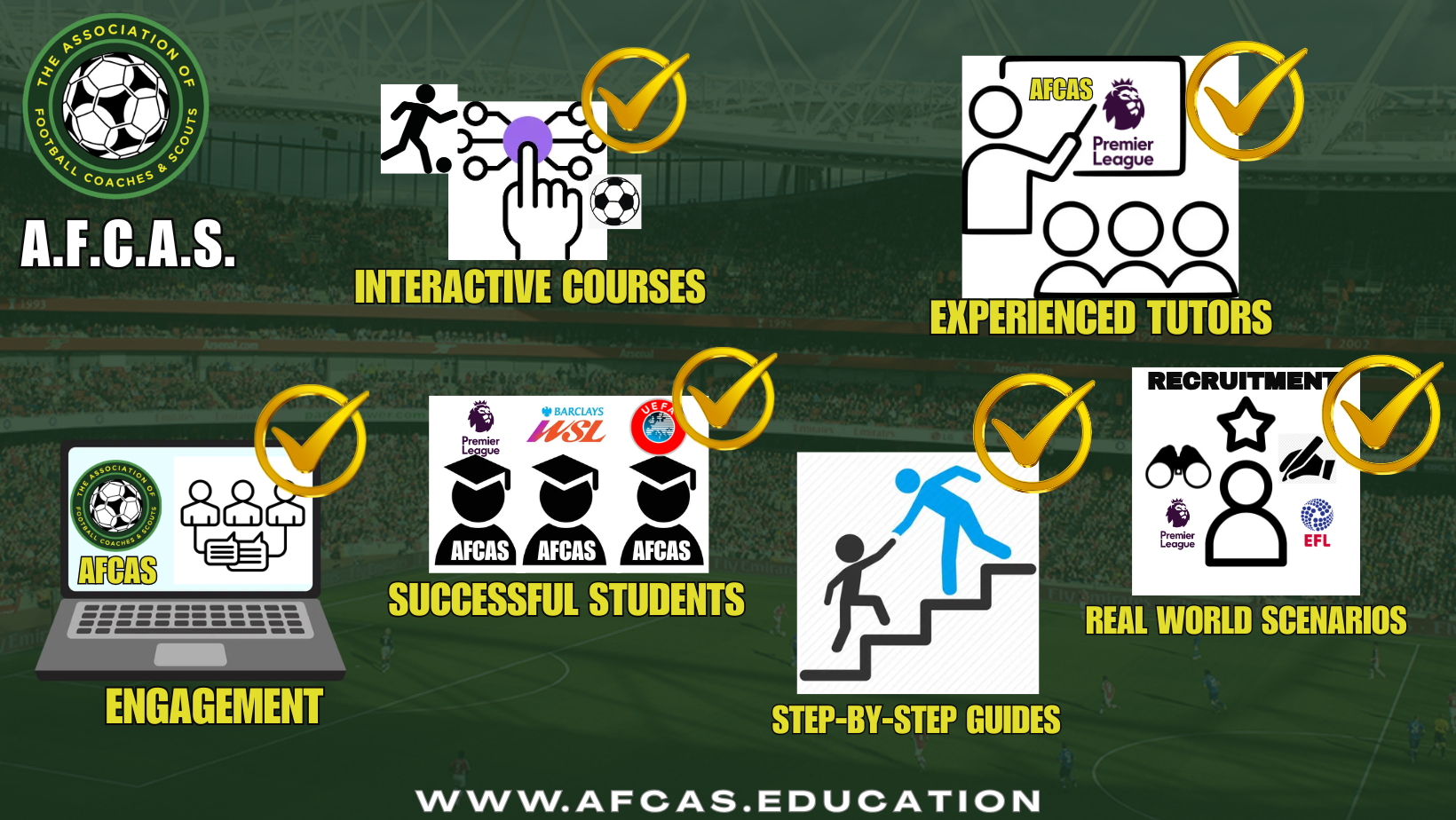
At AFCAS, our Interactive Technical Scouting Program has been designed to teach these foundations step-by-step. Through engaging practical tasks and structured learning, you don’t simply learn what to look for; you understand why it matters.
Our Fully Interactive Positional Scouting Workshops then take your development even further, placing you in realistic scouting and recruitment scenarios while working directly alongside an experienced professional football scout.
Our aim is not simply to educate you, but to prepare you for the realities of working within professional football.
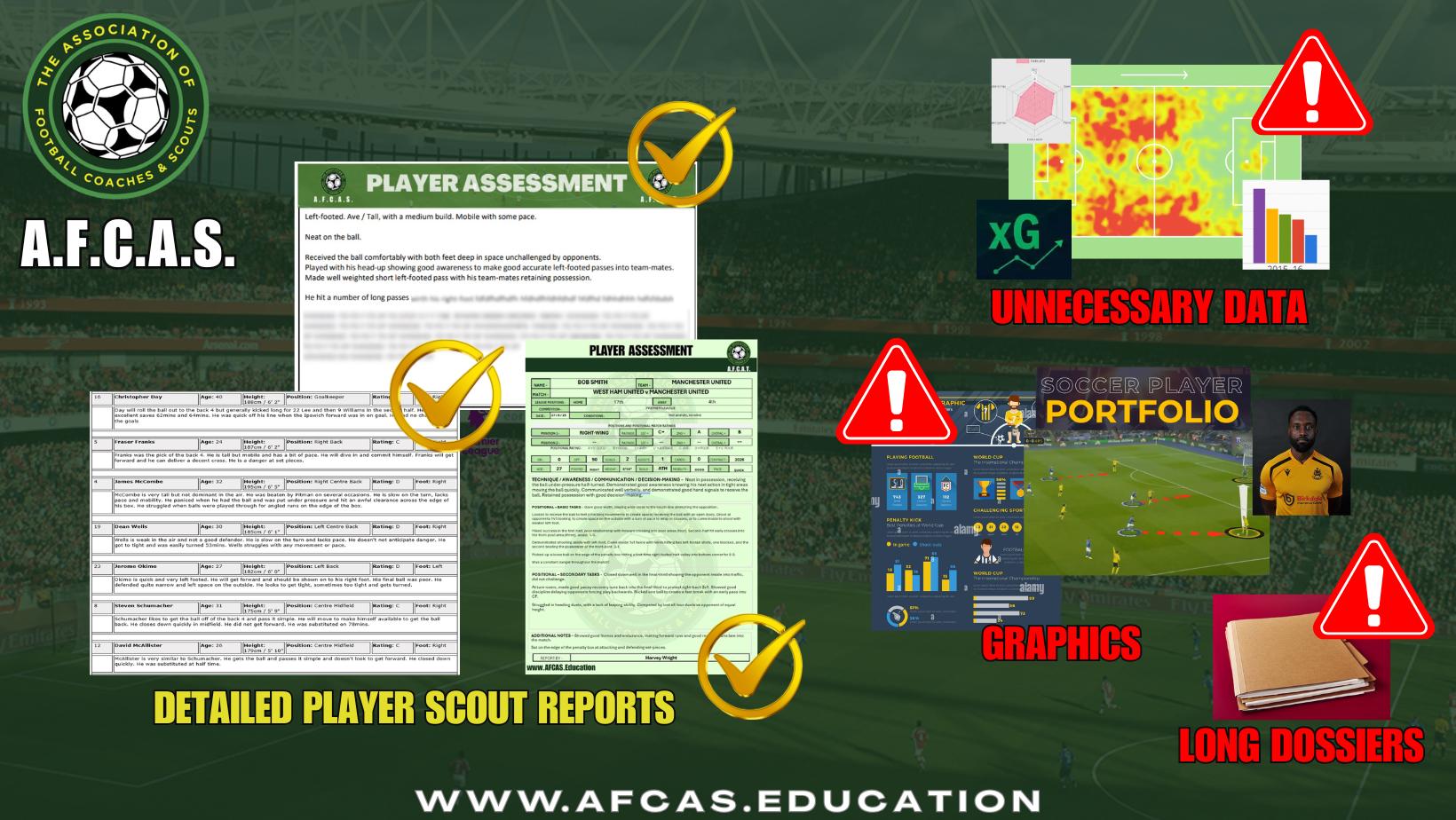
SCOUT REPORTS – FOCUS ON QUALITY, NOT APPEARANCE.
Many new scouts fall into the trap of producing lengthy player dossiers packed with graphics, statistics and colourful charts.
They may look impressive…
But they are rarely what professional decision-makers want.
At the highest level, a scout report should:
- Be clear and concise.
- Highlight the player’s key strengths and weaknesses.
- Paint a clear picture of the player’s performance.
- Be quick and easy to understand.
As the saying goes:
“A picture paints a thousand words.”
In football scouting, your report should create that picture.
A Manager, Chief Scout or Head of Recruitment should be able to read your comments and instantly understand the player, without working through pages of unnecessary information.
Professional clubs already have access to every statistic imaginable through their own recruitment platforms. They don’t need a scout to tell them how many successful passes a player completed or how many duels they won.
What they need is something that data cannot provide, your football judgment.
They want a clear, concise evaluation explaining how the player performed, why they performed that way, and whether they possess the qualities to improve their squad.
That is what separates a scout from someone simply collecting statistics.
FIRST STEPS – LIVE MATCH PRACTICE.
You will not walk straight into a role at a professional football club.
Scouting is a journey.
The first step is simple…
Practice.
Attend live matches at any level and begin applying what you have learnt. Observe players, record information and write reports.
Start by assessing one player.
As your confidence grows, challenge yourself to assess two players, then three, during the same game.
Live football develops observation skills that simply cannot be replicated elsewhere.
Every match attended is another step in your development.
GAINING EXPERIENCE AND RECEIVING FEEDBACK.
Once you have developed confidence in your work, approach local non-league or semi-professional clubs and offer your services.
Most clubs will welcome enthusiastic support.
However, there is one thing you should always ask for in return:
Feedback.
Without feedback there is no development.
Speak directly to the Manager, Coach, or Head Scout, receiving your reports whenever possible.
Avoid passing reports through third parties.
Direct communication allows you to receive honest feedback, build trust with the people making football decisions, and ensures your work is recognised by those you are supporting.
Professional relationships are built through dialogue—not by remaining an anonymous name, sending reports through someone else.
As trust develops, so do opportunities.
NETWORKING – BUILD RELATIONSHIPS WITHIN THE GAME.
Attend games.
Introduce yourself.
Speak to people.
The more time you spend around football, the more opportunities you will create.
Networking is not an optional part of scouting.
It is an essential part of building a successful career.

THE NEXT STEP.
As your confidence grows, the next stage is targeting the right football clubs and making the right first impression.
Your success will always come back to three things:
- Your football knowledge.
- The quality of your work.
- The value you can offer a club.
Not the number of certificates hanging on your wall.
START YOUR FOOTBALL SCOUTING JOURNEY THE RIGHT WAY.
At AFCAS, we don’t just teach football scouting; we prepare you for the realities of working within professional football.
Our Fully Interactive Technical Scouting Program and Positional Scouting Workshops are designed to develop your knowledge step by step, giving you the confidence, practical experience, and understanding needed to progress within the game.
If you’re serious about becoming a football scout, don’t simply collect certificates.
Invest in your knowledge. Build the right foundations. Learn from people who have done the job.
Your football scouting journey starts here. – click here – Our AFCAS – self-paced technical scouting program
AFCAS STUDENTS
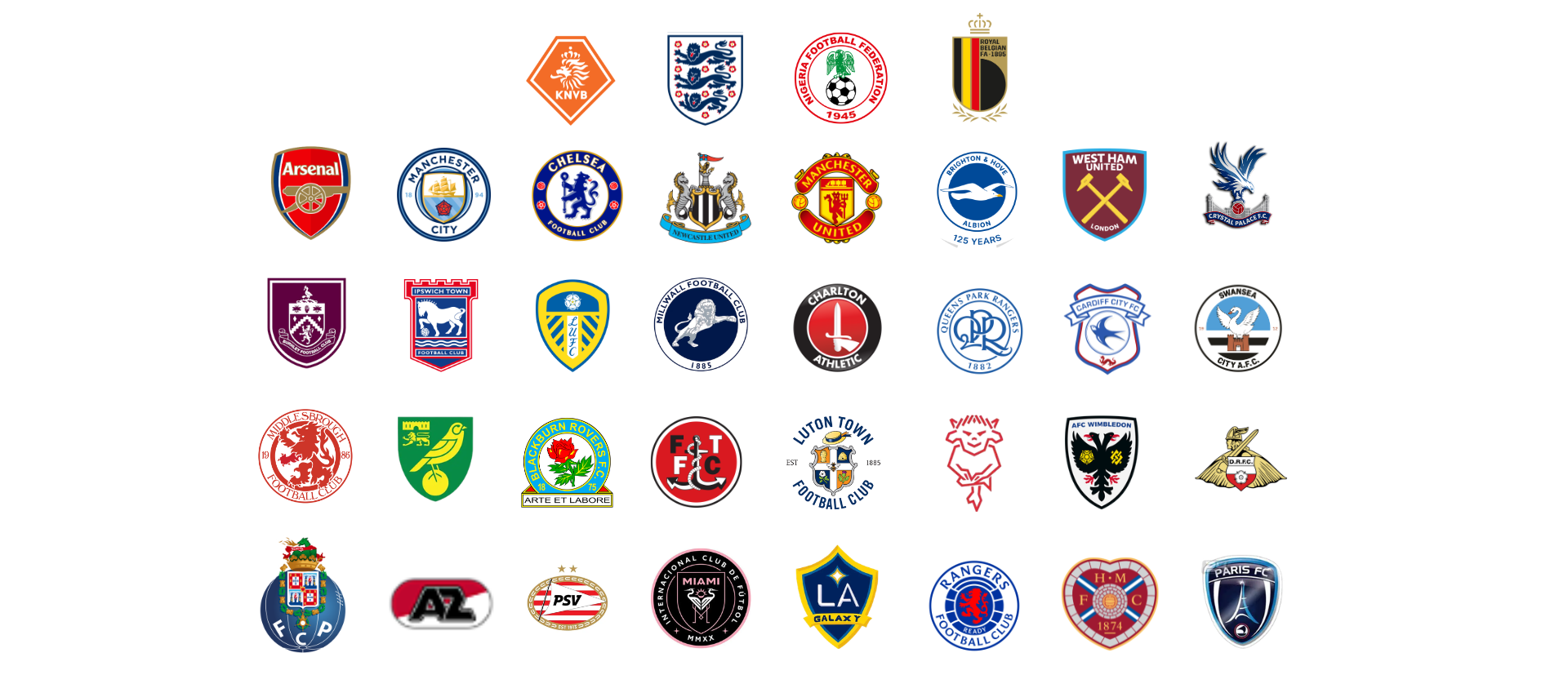
Our students have joined AFCAS from, or progressed to opportunities with, some of the world’s leading football clubs and associations, including:
National Football Associations
Dutch FA • English FA • Nigerian FA • Belgian FA
Professional Clubs
Arsenal • Manchester City • Chelsea • Manchester United • Newcastle United • Brighton & Hove Albion • West Ham United • Crystal Palace
Burnley • Ipswich Town • Leeds United • Millwall • Charlton Athletic • Queens Park Rangers • Cardiff City • Swansea City
Middlesbrough • Norwich City • Blackburn Rovers • Fleetwood Town • Luton Town • Lincoln City • AFC Wimbledon • Doncaster Rovers
FC Porto • AZ Alkmaar • PSV Eindhoven • Inter Miami • LA Galaxy • Rangers • Heart of Midlothian • Paris FC
…and many more.
Start your AFCAS – Scouting Journey today – Click here
AFCAS STUDENT TESTIMONIES –

The AFCAS INTERACTIVE TECHNICAL SCOUTING PROGRAM – Click here for Special offer pack – Level 1 – Level 3.
Frequently Asked Questions (FAQ)
What does a football scout do?
There are two main types of football scouting roles: Player Scouting (Recruitment Scouting) and Opposition Scouting.
A Player Scout is responsible for identifying, observing and assessing individual players. They evaluate technical ability, tactical understanding, physical attributes and psychological characteristics before producing structured scout reports to support recruitment decisions.
An Opposition Scout focuses on analysing upcoming opponents. Their role is to assess the opposition’s playing style, strengths, weaknesses, key players, tactical systems and set plays before producing detailed reports for the manager and coaching staff to help prepare for future matches.
Although both roles involve observation and analysis, they require different reporting structures and objectives.
How do I become a football scout?
Becoming a football scout starts by learning how to observe and assess players correctly.
The most effective way to do this is through structured, interactive education delivered by experienced football scouts who have worked within the professional game. Learning the correct techniques is only the first step—the next stage is putting those techniques into practice by attending live matches and consistently assessing players and teams.
The more experience you gain observing live football and producing professional-quality scout reports, the more confident and competent you become.
Like any profession, scouting is developed through learning, practice and continuous improvement.
Do I need coaching or scouting qualifications?
No qualification or certificate guarantees a role within professional football.
When clubs recruit scouts, they are looking for people who understand the recruitment process, can accurately identify and assess players, and can produce concise, professional scout reports that support recruitment decisions.
As you progress into more senior scouting or recruitment positions, some clubs may require National FA Talent Identification qualifications alongside proven experience working within professional football. However, qualifications complement experience—they do not replace it.
For someone looking to secure their first opportunity, demonstrating your ability will always carry more weight than simply listing certificates on your CV.
Can I become a football scout without playing professionally?
Absolutely.
You do not need to have been a professional footballer—or even a coach—to become a successful football scout.
While previous playing or coaching experience can provide a useful understanding of the game, it is not essential. Many successful scouts have developed their expertise through studying the game, learning structured player assessment techniques, and observing thousands of live matches.
Anyone with a genuine passion for football, a willingness to learn, and the commitment to continually improve can develop the skills needed to become a football scout.
How do football scouts identify talented players?
Talent identification is far more than recognising a player who performs well in one match.
Professional football scouts assess players using a structured approach, evaluating their technical ability, tactical understanding, physical qualities and psychological characteristics. They also consider factors such as decision-making, consistency, game understanding, communication, positional responsibilities and how players perform both in space and under pressure.
Learning how to observe these qualities consistently is one of the most important skills a scout can develop, and these assessment techniques can be learned through structured education and regular match observation.
What makes a good football scout report?
A good scout report is clear, concise and easy to understand.
Its purpose is to communicate the key information a Chief Scout, Head of Recruitment or Manager needs to make informed decisions.
Professional scout reports should:
- Clearly identify the player’s strengths and areas for development.
- Be based on factual observations rather than opinion.
- Highlight the player’s suitability for a particular level or style of football.
- Present information in a concise, easy-to-read format.
Professional clubs are not looking for lengthy dossiers filled with unnecessary graphics, statistics and complex data. They want reports that quickly provide accurate, relevant information and paint a clear picture of the player’s performance and potential.
How do I gain football scouting experience?
Once you have learned the foundations of player assessment, the next step is to put those skills into practice.
Attend as many live matches as possible and begin producing structured scout reports on individual players and teams. Volunteer to work with local grassroots, amateur, non-league or semi-professional clubs, where you can gain valuable practical experience while continuing to develop your observation and reporting skills.
Seek regular feedback from experienced scouts and recruitment professionals to help refine your work.
As your confidence grows and your reports consistently reach a professional standard, you will be in a much stronger position to approach professional football clubs.
This is the pathway followed by many AFCAS students who have progressed from learning the fundamentals of scouting to working with professional clubs both in the UK and internationally.
Further Reading – Football Scouting Courses: What should you expect from a Scout Education Provider
Further Reading – Football Scouting: How to Target the Right Club and Making the Perfect First Impression
Further Reading – Football Scouting: The Importance of Live Match Networking as a Football Scout

Originally published by AFCAS – Association of Football Coaches and Scouts
The coaching frameworks, scouting methodologies, player assessment models and educational content contained within the AFCAS Education Hub have been developed from the practical experiences of AFCAS educators working within grassroots, academy, professional and international football.
Original AFCAS Educational Content
The educational content, coaching principles, scouting methodologies and practical frameworks published within the AFCAS Education Hub have been developed through years of professional coaching, scouting and recruitment experience.
These articles represent original AFCAS educational material and are protected by copyright. Any reproduction, adaptation or commercial use without written permission is prohibited.
Please support original football education by sharing links to the original AFCAS articles rather than reproducing their content.
© AFCAS. All Rights Reserved.
About the Author
Ged Searson is the Managing Director of AFCAS and has over 30 years of coaching and scouting experience. He is a former Premier League First Team Scout, former EFL scout and former Chief Scout of the Malawi National Team. Through AFCAS, he has educated coaches and scouts from across the UK and around the world.
Published: 26 June 2026
Author: Ged Searson
Updated: 27 June 2026
7 comments on “SCOUTING – BEGINNER’S GUIDE TO FOOTBALL SCOUTING”