The Hidden Dangers of Scouting During the FIFA World Cup: Why Great Recruitment Requires Context
Every four years, the biggest names in football come together on the world’s biggest stage.
The FIFA World Cup brings together elite players, global media attention, and recruitment staff from almost every professional football club. Managers, Sporting Directors, Heads of Recruitment, Scouts and Analysts travel to the tournament hoping to identify players capable of strengthening their squads. For those unable to attend in person, countless more will spend hours watching matches from television screens and laptops around the world.
It appears to be the perfect scouting environment.
In reality, it can also be one of the most dangerous.
Now, when I talk about the dangers of scouting during the World Cup, I’m not referring to the physical dangers that I experienced while working as Chief Scout and Analyst with the Malawi National Team during the 2022 Africa Cup of Nations in Cameroon.
At AFCON, our team and staff regularly travelled under the protection of armed military escorts, and when travelling independently to scout upcoming opponents, I too was accompanied by armed security. Fortunately, that was simply part of operating within the tournament environment.
The dangers I’m referring to here are very different.
They are the dangers of recruitment decision-making.
Having experienced an international tournament from inside a national team environment, I saw first-hand how easily exceptional tournament performances can influence opinions. While supporters see memorable goals and headlines, recruitment departments must remain objective, separating short-term tournament form from long-term player quality.
International tournaments provide fantastic opportunities to scout players—but they should never replace a structured recruitment process.

TOURNAMENT FORM vs LONG-TERM PERFORMANCE.
One of the biggest mistakes a recruitment department can make is allowing a tournament to outweigh years of evidence.
A World Cup campaign typically lasts between three and seven matches.
A domestic season consists of forty to fifty matches across different competitions.
Making a significant recruitment decision based on such a small sample size introduces unnecessary risk.
Tournament football is unique.
Players experience extraordinary pressure, emotions run high, preparation time is limited, and every performance is magnified by worldwide media attention.
Some players thrive in this environment.
Others underperform.
Neither necessarily reflects the player’s true level over an entire season.
A professional scout’s responsibility isn’t to become excited by one outstanding tournament performance.
It is to determine whether that performance represents the player’s normal level, or simply an exceptional run of form.
Recruitment decisions worth millions of pounds should never be based on moments.
They should be based on evidence gathered over time.

LESSONS FROM AFCON 2022
One of the biggest lessons I took from working as Chief Scout and Analyst with the Malawi National Team at the 2022 Africa Cup of Nations was that tournament performances rarely tell the complete story.
Before the tournament even began, our scouting and opposition analysis had already identified strengths and weaknesses within many of the players we would face. An important part of that analysis was carried out by a small team of scouting analysts whom I personally selected from AFCAS’s Football Scouting Education Program. These were former AFCAS students whom I believed had developed the knowledge, observation skills and professionalism required to operate within an international tournament environment.
Working alongside me and the Malawi National Team coaching staff, they produced outstanding scouting and opposition analysis throughout the competition. Their preparation, attention to detail and professionalism played an important role in supporting the team as Malawi made history by reaching the knockout stages of the Africa Cup of Nations for the first time.
As the tournament progressed, some of the opposition players we had analysed produced outstanding individual performances and attracted significant transfer interest from clubs around the world.
However, several of the weaknesses we had identified before the tournament later reappeared after those players secured moves to bigger clubs.
It reinforced one of the most valuable lessons in professional recruitment:
International tournaments should confirm your scouting – not replace it.
The clubs that consistently recruit well are rarely those reacting to six outstanding matches.
They are the clubs that already understand the player before the tournament begins.

UNDERSTANDING THE LEVEL OF OPPOSITION.
International football presents another important challenge.
Not every opponent is of the same quality.
As every World Cup demonstrates, some nations have significantly greater depth, infrastructure and player development systems than others.
Likewise, traditional footballing powers can underperform for many reasons:
- Poor preparation.
- Injuries to key players.
- Tactical instability.
- Squad transition.
- Underestimating opponents.
- Fatigue.
When evaluating a player’s performance, professional scouts must always consider the context.
Did the player dominate against significantly weaker opposition?
Were they given more time and space than they would receive in their domestic league?
Did the tactical system maximise their strengths?
Or, equally important…
Did they struggle because the players around them couldn’t perform their roles effectively?
Context is everything.
Recruitment departments should always compare international tournament performances with domestic performances before reaching conclusions.
THE COMFORT FACTOR.
International football often provides players with an environment where they feel comfortable.
They are surrounded by familiar teammates.
They communicate in their native language.
They represent their country.
They understand the coaching methods.
That comfort can positively influence performance.
Moving to another country introduces completely different challenges.
Professional recruitment departments should therefore assess far more than technical ability.
Questions include:
- How adaptable is the player?
- Have they lived abroad before?
- Can they communicate in another language?
- Are they willing to learn?
- How will they adapt to a different football culture?
- Will their personality suit the dressing room?
Talent alone rarely guarantees success.
LOOKING BEYOND THE PLAYER.
Successful recruitment isn’t simply about identifying talent.
It is about understanding the whole person.
Will the player’s family settle?
Do they have the right support network?
Can the club provide cultural integration and language support?
Will life away from football help or hinder performance?
Ignoring these factors can significantly increase the risk attached to any transfer.
The most successful clubs don’t simply recruit footballers.
They recruit people.

THE ADAPTATION TIMELINE.
Another important consideration is patience.
Young players often require time to adapt.
New league.
New teammates.
New country.
New language.
New tactical demands.
Can your club provide that time?
Or are expectations unrealistic?
Even outstanding footballers can struggle if clubs expect immediate success without allowing a period of adaptation.
Recruitment decisions should always align with the club’s long-term strategy.
THE PRACTICAL REALITY
No recruitment process is complete without considering practical matters.
Can the player obtain a visa or work permit?
Do they meet the country’s eligibility requirements?
How long will the process take?
Sometimes the best recruitment decision isn’t determined by football ability—but by legal and administrative realities.
TOURNAMENT SCOUTING SHOULD STRENGTHEN RECRUITMENT – NOT REPLACE IT.
International tournaments provide scouts with an outstanding opportunity to observe players performing under pressure against different styles of opposition.
However, tournament performances should form just one part of a much broader recruitment process.
The most successful recruitment departments combine:
- Long-term live scouting.
- Video scouting.
- Performance analysis and data.
- Character and personality assessment.
- Tactical suitability.
- Medical screening.
- Cultural and environmental considerations.
- Background research.
- Practical eligibility requirements.
World Cups don’t create great players.
They reveal them.
The challenge for professional scouts is recognising whether an outstanding tournament reflects the player’s true level, or simply an exceptional few weeks.
The FIFA World Cup should never replace a recruitment process.
It should strengthen one.
Scout the player.
Understand the context.
Then make the recruitment decision.
The biggest mistakes in football recruitment are rarely made because a scout missed a talented player.
They are made when clubs fall in love with moments instead of evidence.
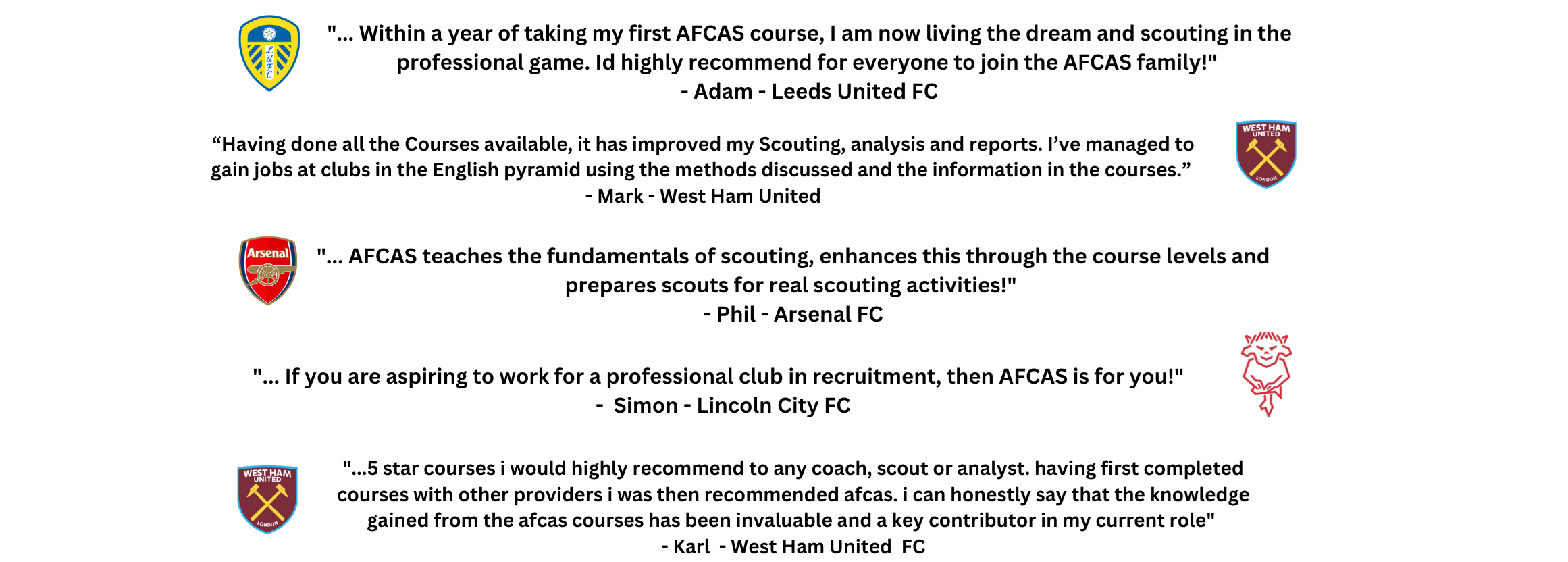
Have you joined the AFCAS scouting program yet?
This is the pathway followed by many AFCAS students who have progressed from learning the fundamentals of scouting to working with professional clubs both in the UK and internationally.
You are joining a community of people who genuinely want to see you develop, progress and build a successful future in football scouting.
AFCAS – Technical Scouting Program – https://afcas.education/football-scouting
Further Reading – Football Scouting Courses: What should you expect from a Scout Education Provider
Further Reading – Football Scouting: How to Target the Right Club and Making the Perfect First Impression
Further Reading – Football Scouting: The Importance of Live Match Networking as a Football Scout

Originally published by AFCAS – Association of Football Coaches and Scouts
The coaching frameworks, scouting methodologies, player assessment models and educational content contained within the AFCAS Education Hub have been developed from the practical experiences of AFCAS educators working within grassroots, academy, professional and international football.
Original AFCAS Educational Content
The educational content, coaching principles, scouting methodologies and practical frameworks published within the AFCAS Education Hub have been developed through years of professional coaching, scouting and recruitment experience.
These articles represent original AFCAS educational material and are protected by copyright. Any reproduction, adaptation or commercial use without written permission is prohibited.
Please support original football education by sharing links to the original AFCAS articles rather than reproducing their content.
© AFCAS. All Rights Reserved.
About the Author
Ged Searson is the Managing Director of AFCAS and has over 30 years of coaching and scouting experience. He is a former Premier League First Team Scout, former EFL scout and former Chief Scout of the Malawi National Team. Through AFCAS, he has educated coaches and scouts from across the UK and around the world.
Published: 26 June 2026
Author: Ged Searson
Updated: 27 June 2026