PROFESSIONAL FOOTBALL SCOUTING: WHY CONTEXT IS EVERYTHING WHEN ASSESSING PLAYERS.
“You deal in hard facts and you must never back hunches. Watch a player in different conditions, not just at home, but in tough away matches when they will be under pressure. And you never ever bid for somebody on the basis of what they might do, always what you know they can do.” — Brian Clough
Those words from Brian Clough remain just as relevant today as they were during one of the most successful recruitment partnerships in football history. Together with Peter Taylor, Clough built league-winning teams at Derby County before going on to achieve the remarkable feat of winning back-to-back European Cups with Nottingham Forest.
Their recruitment philosophy was simple.
Deal in facts.
Not opinions.
Not hype.
Not one outstanding performance.
Facts gathered through careful observation over time.
Unfortunately, modern football has made it easier than ever to form quick opinions. A scout can watch a highlight reel, study performance data, analyse clips online or watch a player perform in one televised match and feel they have seen enough.
Professional recruitment departments know otherwise.
One match rarely tells the full story.
One statistic rarely explains the complete performance.
One environment rarely reveals the true character of a player.
The role of a professional football scout is not simply to identify talent. It is to understand whether that talent can be consistently reproduced in different situations, against different opponents and under different pressures.

Masters of Recruitment – Peter Taylor and Brian Clough.

CONTEXT IS EVERYTHING.
Every football match presents a different challenge.
A player who dominates at home may struggle away from home.
A player who looks composed against lower-table opposition may find it difficult when facing elite players.
Some players thrive when the spotlight is on them in front of television cameras, while others quietly produce consistent performances every single week away from the media attention.
Likewise, a player may appear outstanding on video analysis, but live observation might reveal weaknesses that statistics and camera angles simply cannot show.
This is why successful professional clubs rarely base recruitment decisions on a single observation.
They build evidence.
Every viewing becomes another piece of a much larger picture.
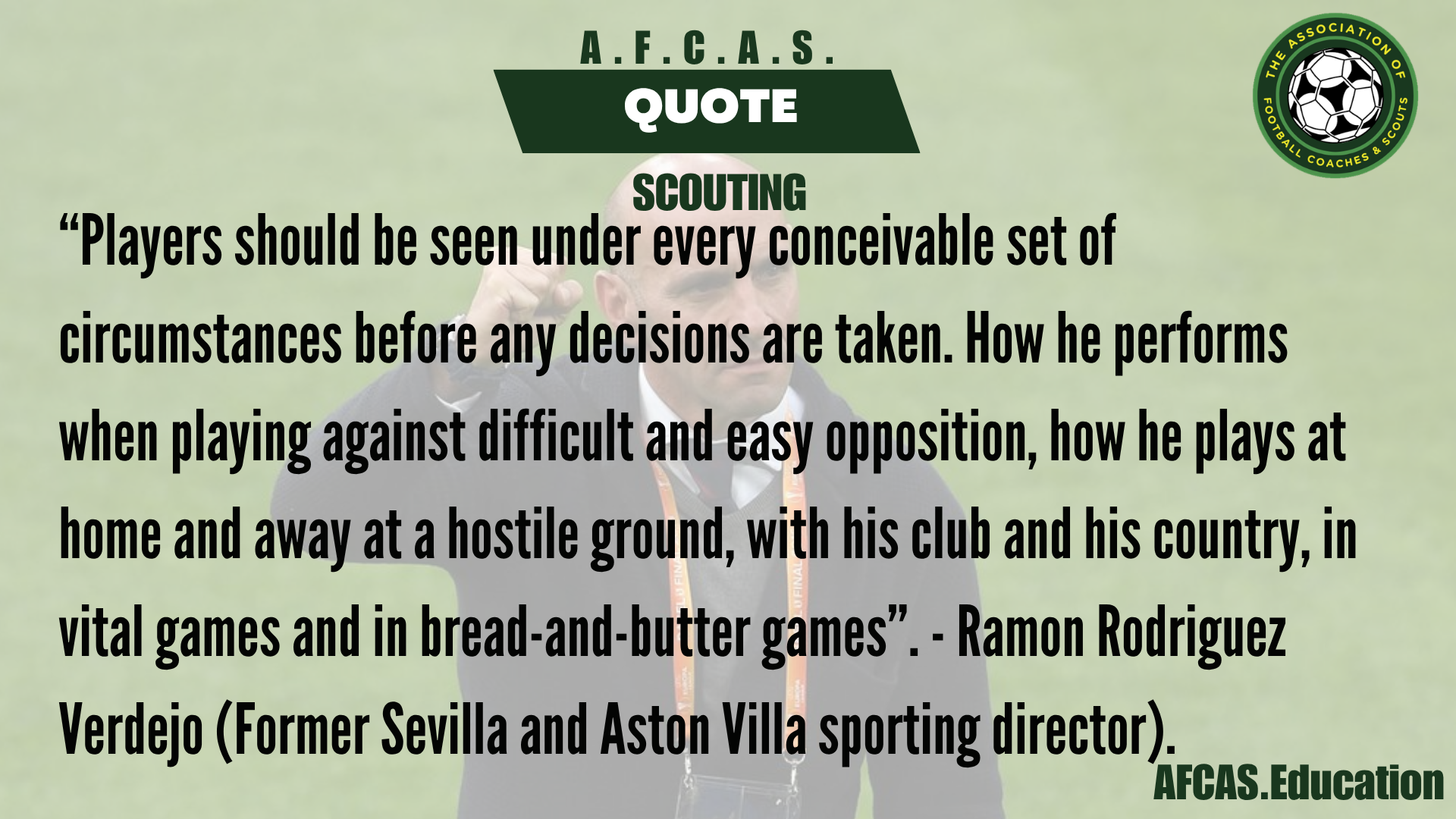
THERE IS NO SUCH THING AS THE PERFECT VIEWING.
Professional scouts constantly ask themselves questions during every assessment.
- How did the player perform under pressure?
- Was this performance typical?
- How strong was the opposition?
- Was the player at home or away?
- Were the weather conditions a factor?
- Was the tactical system helping or exposing the player?
- How did the player react when things weren’t going well?
- What was their communication like?
- What happened away from the ball?
Every observation provides another layer of understanding.
The objective is not simply to identify a talented player.
It is to reduce recruitment risk.
THE DIFFERENT SPOTLIGHTS.
Throughout a season, players perform under many different spotlights.
Some perform in front of large television audiences.
Others perform in difficult away grounds with hostile supporters.
Some excel in domestic competitions but struggle in European football. Or the complete reverse of this, performing better in Europe than in their domestic competition.
Others produce their best football during local derby matches where the emotional intensity is far greater than a normal league fixture.
The challenge for scouts is understanding whether the player’s performance is repeatable regardless of the environment.
That is why players should be assessed under different “spotlights” — and also in the “daylight” of ordinary league matches, where consistency often tells a more accurate story than one spectacular performance.

THE BUILDING BLOCKS OF PROFESSIONAL PLAYER ASSESSMENT
Professional recruitment departments rarely rely on one source of information.
Instead, they combine multiple forms of evidence.
These include:
- Live match observation.
- Video scouting.
- Performance data.
- Opposition strength.
- Tactical context.
- Character assessment.
- Communication.
- Decision-making.
- Performances in different environments.
- Consistency over time.
Only when these pieces begin to align can clubs make informed recruitment decisions.

FOUR QUESTIONS EVERY RECRUITMENT DEPARTMENT / SCOUT SHOULD ASK
When assessing any player, four important questions should always be considered.
- Have I Seen The Player In Different Environments?
A player should never be judged solely on home performances or comfortable situations.
Professional scouts want to understand how players perform away from home, in hostile atmospheres, difficult weather conditions and under genuine pressure.
Different environments reveal different qualities.
- Have I Seen The Player Against Different Levels Of Opposition?
Outstanding performances against weaker opponents do not automatically translate to success at a higher level.
Equally, a player performing well despite their team struggling against stronger opposition may demonstrate qualities that statistics alone never reveal.
Understanding the context of the opposition is essential.
- Have I Used Both Live And Video Scouting?
Video analysis has transformed recruitment and provides enormous value.
However, live observation still allows scouts to assess communication, off-the-ball movement, personality, leadership and environmental factors that cameras often miss.
The strongest recruitment decisions combine both methods.
- Am I Looking Beyond The Statistics?
Performance data is an excellent tool.
It identifies trends.
It highlights patterns.
It supports decision-making.
But statistics should support the recruitment process, not replace it.
Professional scouting still relies on understanding the person behind the numbers.

Building Evidence, Not Opinions
Perhaps the greatest difference between inexperienced scouts and experienced recruitment departments is patience.
Inexperienced scouts often form opinions quickly.
Experienced scouts collect evidence.
Every match observed either strengthens or weakens an opinion.
Every report contributes to a larger body of knowledge.
Recruitment decisions should never be based on excitement.
They should be based on evidence.
IN THE SERIES.
This article introduces the principles of contextual player assessment.
The following AFCAS articles explore each subject in greater detail:
Together, these articles form part of the AFCAS approach to professional football scouting and player recruitment.
Final Thoughts
Football scouting is not about collecting opinions.
It is about collecting evidence.
Every player performs differently depending on the quality of the opposition, the tactical demands, the environment, the weather, the pressure and the people around them.
The professional scout’s responsibility is to understand all of those influences before recommending a player.
Because successful recruitment is rarely about finding the player who produced one outstanding performance.
It is about identifying the player who can consistently reproduce that level of performance, regardless of the circumstances.
As Brian Clough reminded us decades ago, recruitment should never be based on what a player might do.
It should be based on what you know they can do.
That is why, in professional football scouting…
Context is everything.

AFCAS STUDENTS
Our students have joined AFCAS from, or progressed to opportunities with, some of the world’s leading football clubs and associations, including:
National Football Associations
Dutch FA • English FA • Nigerian FA • Belgian FA
Professional Clubs
Arsenal • Manchester City • Chelsea • Manchester United • Newcastle United • Brighton & Hove Albion • West Ham United • Crystal Palace
Burnley • Ipswich Town • Leeds United • Millwall • Charlton Athletic • Queens Park Rangers • Cardiff City • Swansea City
Middlesbrough • Norwich City • Blackburn Rovers • Fleetwood Town • Luton Town • Lincoln City • AFC Wimbledon • Doncaster Rovers
FC Porto • AZ Alkmaar • PSV Eindhoven • Inter Miami • LA Galaxy • Rangers • Heart of Midlothian • Paris FC
…and many more.
Start your AFCAS – Scouting Journey today – Click here

Originally published by AFCAS – Association of Football Coaches and Scouts
The coaching frameworks, scouting methodologies, player assessment models and educational content contained within the AFCAS Education Hub have been developed from the practical experiences of AFCAS educators working within grassroots, academy, professional and international football.
Original AFCAS Educational Content
The educational content, coaching principles, scouting methodologies and practical frameworks published within the AFCAS Education Hub have been developed through years of professional coaching, scouting and recruitment experience.
These articles represent original AFCAS educational material and are protected by copyright. Any reproduction, adaptation or commercial use without written permission is prohibited.
Please support original football education by sharing links to the original AFCAS articles rather than reproducing their content.
© AFCAS. All Rights Reserved.
About the Author
Ged Searson is the Managing Director of AFCAS and has over 30 years of coaching and scouting experience. He is a former Premier League First Team Scout, former EFL scout and former Chief Scout of the Malawi National Team. Through AFCAS, he has educated coaches and scouts from across the UK and around the world.
Published: 26 June 2026
Author: Ged Searson
Updated: 27 June 2026