
FOOTBALL SCOUTING – GOALKEEPER SCOUTING IN FOOTBALL: WHAT SCOUTS REALLY LOOK FOR
- 16 June 2026
- Ged Searson
- 0
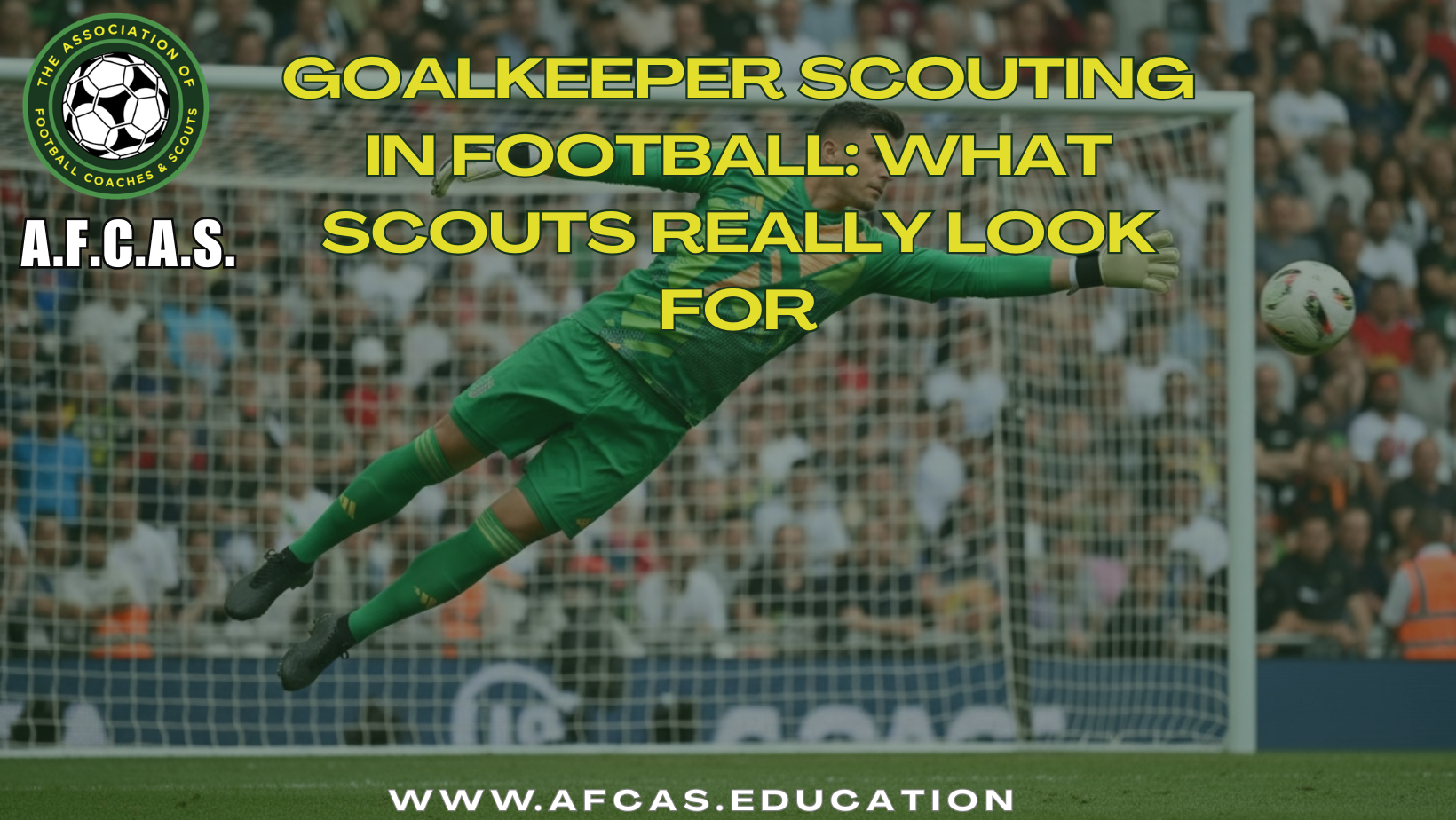

GOALKEEPER SCOUTING IN FOOTBALL: WHAT SCOUTS REALLY LOOK FOR.
In modern football, goalkeeper scouting is one of the most specialised areas of player assessment and recruitment.
While outfield scouting often dominates discussion, identifying the right goalkeeper requires a deeper, more nuanced understanding of the position.
And the key question is not simply:
👉 Is the goalkeeper technically good?
But rather:
👉 Do they fit the team, the league, and the demands of the game?
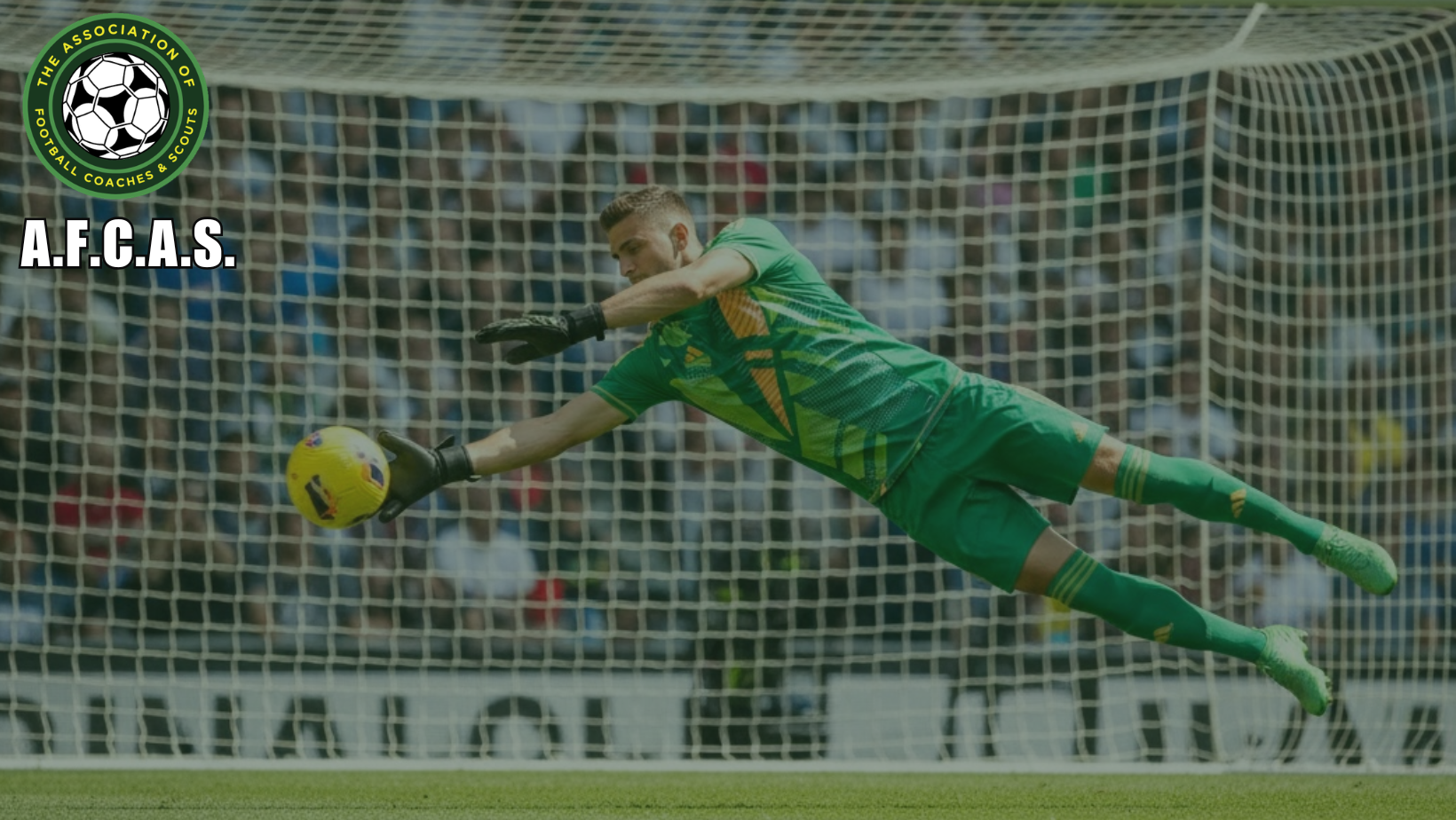
Why Goalkeeper Scouting Is Different
Goalkeepers operate under completely different pressures compared to outfield players.
A striker can miss chances and recover. A midfielder can lose possession and reset.
Continue Reading
Enter your email to unlock this full article and join the AFCAS coaching & scouting community.
No spam. Unsubscribe anytime.
But for a goalkeeper:
👉 One mistake can define a performance.
This makes goalkeeper analysis in football scouting unique.
It requires assessing:
- Mental resilience
- Decision-making under pressure
- Communication and organisation
- Consistency over time
These are areas that are not always reflected in goalkeeper performance data.
Learning from the Best: Identifying Goalkeeping Potential
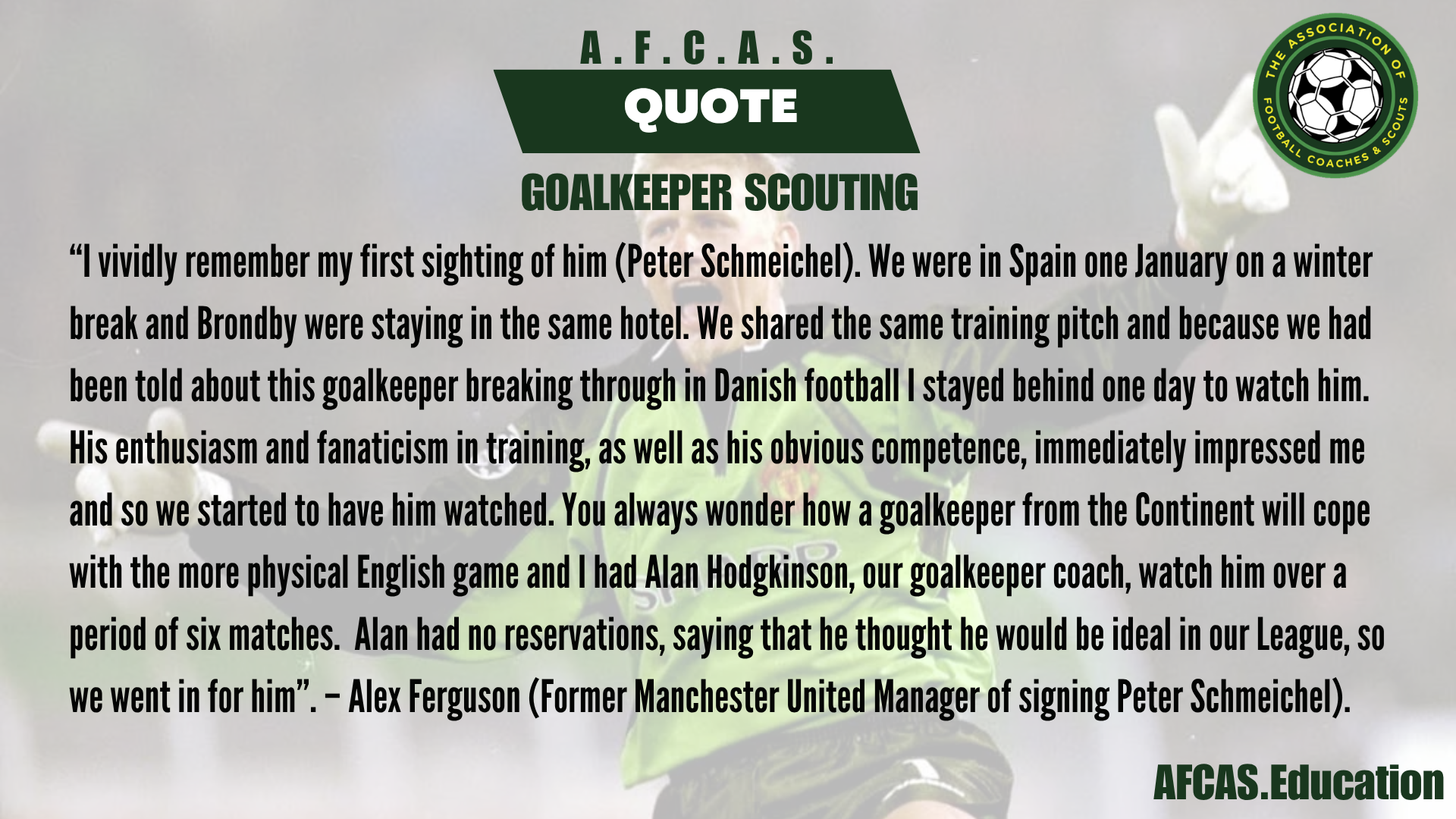
Former Manchester United manager Alex Ferguson recalled his first sighting of Peter Schmeichel:
“His enthusiasm and fanaticism in training, as well as his obvious competence, immediately impressed me…”
Importantly, it wasn’t just ability that stood out.
It was:
- Mentality
- Personality
- Approach to training
Ferguson then ensured the player was watched multiple times, including by a specialist goalkeeping coach, before making a decision.
This highlights a key principle in elite football recruitment:
👉 Goalkeepers must be assessed in context, not in isolation.
Key Areas in Goalkeeper Scouting
When assessing a goalkeeper, scouts must go beyond basic metrics.
- Shot-Stopping Ability
- Reactions and reflexes
- Positioning
- Handling under pressure
- Decision-Making
- When to come for crosses
- When to stay
- Risk vs reward judgement
- Communication & Organisation
- How they organise the defence
- Vocal presence
- Leadership from the back
- Distribution & Modern Demands
- Building from the back
- Passing range and accuracy
- Comfort under pressure
- Mentality & Resilience
- Response to mistakes
- Confidence levels
- Composure in high-pressure moments
These areas form the foundation of goalkeeper scouting reports in football.
The Importance of Style and System Fit
One of the biggest mistakes in football recruitment is signing a goalkeeper based purely on ability, without considering system fit.
Ask:
👉 Does the goalkeeper suit the team’s style of play?
👉 Can they play in a high defensive line?
👉 Are they comfortable with the ball at their feet?
👉 Can they handle the physical demands of the league?
A goalkeeper who excels in one system may struggle in another.
This is why contextual scouting in football is essential.
Why Data Alone Is Not Enough
Modern football increasingly uses data analysis in goalkeeper scouting.
While useful, data cannot fully measure:
- Communication
- Leadership
- Presence
- Decision-making under pressure
These are qualities that define top goalkeepers.
And they can only be properly assessed through:
👉 Live observation
👉 Experience
👉 The trained eye
Developing as a Goalkeeper Scout
Every scout, not just goalkeeper specialists, should develop an understanding of the position.
Because goalkeepers:
- Influence team structure
- Control defensive organisation
- Impact overall performance
Improving your ability in goalkeeper player assessment will make you a more complete scout.
Final Thought
Goalkeeper scouting is not just about identifying ability.
It is about understanding:
- The role
- The environment
- The demands of the game
👉 And recognising the qualities that truly matter when it counts.
AFCAS STUDENTS
Our students have joined AFCAS from, or progressed to opportunities with, some of the world’s leading football clubs and associations, including:
National Football Associations
Dutch FA • English FA • Nigerian FA • Belgian FA
Professional Clubs
Arsenal • Manchester City • Chelsea • Manchester United • Newcastle United • Brighton & Hove Albion • West Ham United • Crystal Palace
Burnley • Ipswich Town • Leeds United • Millwall • Charlton Athletic • Queens Park Rangers • Cardiff City • Swansea City
Middlesbrough • Norwich City • Blackburn Rovers • Fleetwood Town • Luton Town • Lincoln City • AFC Wimbledon • Doncaster Rovers
FC Porto • AZ Alkmaar • PSV Eindhoven • Inter Miami • LA Galaxy • Rangers • Heart of Midlothian • Paris FC
…and many more.
Start your AFCAS – Scouting Journey today – Click here
AFCAS – Football Scouting Education
At AFCAS, we develop scouts who understand the game in full, including specialist areas such as goalkeeper scouting and player analysis.
If you want to improve your football scouting knowledge and learn how to assess players properly:
👉 https://afcas.education/football-scouting
Develop the skills that separate average scouting from elite decision-making.
Frequently Asked Questions (FAQ)
What do football scouts look for in a goalkeeper?
Many people assume that goalkeeper scouting is simply about assessing shot-stopping and handling. While these are important, they are only the beginning.
Professional football scouts assess a goalkeeper’s positioning, decision-making, handling, communication, command of the penalty area, distribution with both hands and feet, aerial ability, and their composure under pressure.
In the modern game, a goalkeeper is often the first attacker as well as the last defender. Their ability to receive the ball, make correct decisions in possession, and distribute accurately to build attacks has become just as important as their ability to make saves.
A complete goalkeeper assessment looks at every aspect of the position, not simply the spectacular saves.
How is goalkeeper scouting different from outfield scouting?
Goalkeeper scouting is one of the most specialised areas within football recruitment.
A general scout can assess the fundamental qualities of a goalkeeper, but an experienced goalkeeper coach or specialist goalkeeper scout can often identify technical details that others may miss.
Small adjustments to positioning, body shape, footwork or decision-making can have a significant impact on whether a goalkeeper prevents or concedes a goal. These finer technical details require specialist knowledge developed through years of experience working specifically with goalkeepers.
This is why many professional clubs utilise dedicated goalkeeper scouts or specialist goalkeeper coaches as part of their recruitment process.
What attributes are most important when scouting a goalkeeper?
A professional goalkeeper scout should assess a goalkeeper across several key areas, including:
- Positioning
- Decision-making
- Handling
- Communication
- Distribution with hands and feet
- Footwork and mobility
- Command of the penalty area
- Composure under pressure
- Leadership and organisation of the defence
Rather than focusing on one outstanding quality, scouts are looking for goalkeepers who consistently demonstrate strong all-round performance and whose attributes suit the style of play of the club they are being considered for.
Should goalkeepers be assessed differently depending on the team’s style of play?
Every goalkeeper should first be assessed against the fundamental requirements of the position.
For example, if a senior goalkeeper cannot consistently handle the ball cleanly, outstanding distribution alone is unlikely to compensate for those deficiencies.
However, once those fundamental qualities have been established, the goalkeeper must also be assessed against the specific demands of the club’s playing style.
A team that builds play from the back may require exceptional receiving skills and distribution under pressure, while another team may prioritise command of the penalty area, aerial dominance and longer distribution.
Ultimately, recruitment should identify goalkeepers who possess both the core qualities required for the position and the additional attributes that complement the club’s tactical philosophy.
Why is goalkeeper decision-making so important?
A goalkeeper may possess excellent technique, athleticism and handling ability, but poor decision-making will often lead to costly mistakes.
Knowing when to stay on the goal line, when to claim a cross, when to sweep behind the defence and advance, when to play short or long, and when to slow or accelerate the game are all examples of decisions that can directly influence the outcome of a match.
For this reason, decision-making is one of the most important areas a goalkeeper scout should assess, as consistently good decisions often separate good goalkeepers from outstanding ones.
How many matches should a goalkeeper be watched before making a recommendation?
As many as possible.
A goalkeeper should ideally be observed live over multiple matches and via video.
Scouts should aim to assess the goalkeeper against different qualities of opposition, different tactical systems and different match situations. They should also observe performances in varying weather conditions, home and away fixtures, and under different levels of pressure.
Watching a goalkeeper on multiple occasions allows scouts to identify recurring strengths, weaknesses and behavioural patterns rather than making decisions based on one exceptional performance, or one poor performance.
The more evidence collected, the more accurate and reliable the final assessment will be.
Can statistics alone assess a goalkeeper?
No.
Statistics can highlight trends and provide useful supporting information, but they should never replace live observation and the “eye test.”
Every statistic must be considered within its context.
For example, a goalkeeper playing for a dominant team against weaker opposition may naturally face fewer shots than a goalkeeper playing for a struggling team against stronger opponents. Save percentages, clean sheets and passing statistics can therefore paint a misleading picture if the quality of the opposition, tactical style of the team and overall match context are ignored.
Professional scouts combine data with live observation, video analysis and contextual understanding to produce a balanced assessment. Statistics support the scouting process, they should never replace it.
Further Reading – Football Scouting: A Beginner’s Guide to Football Scouting
Further Reading – Football Scouting Courses: What should you expect from a Scout Education Provider
Further Reading – Football Scouting: How to Target the Right Club and Making the Perfect First Impression
Further Reading – Football Scouting: The Importance of Live Match Networking as a Football Scout
Further Reading – Football Scouting: The Eye and Ear Test In Football Scouting: Why Decision-Making and Communication Matter

Originally published by AFCAS – Association of Football Coaches and Scouts
The coaching frameworks, scouting methodologies, player assessment models and educational content contained within the AFCAS Education Hub have been developed from the practical experiences of AFCAS educators working within grassroots, academy, professional and international football.
Original AFCAS Educational Content
The educational content, coaching principles, scouting methodologies and practical frameworks published within the AFCAS Education Hub have been developed through years of professional coaching, scouting and recruitment experience.
These articles represent original AFCAS educational material and are protected by copyright. Any reproduction, adaptation or commercial use without written permission is prohibited.
Please support original football education by sharing links to the original AFCAS articles rather than reproducing their content.
© AFCAS. All Rights Reserved.
About the Author
Ged Searson is the Managing Director of AFCAS and has over 30 years of coaching and scouting experience. He is a former Premier League First Team Scout, former EFL scout and former Chief Scout of the Malawi National Team. Through AFCAS, he has educated coaches and scouts from across the UK and around the world.
Published: 26 June 2026
Author: Ged Searson
Updated: 27 June 2026