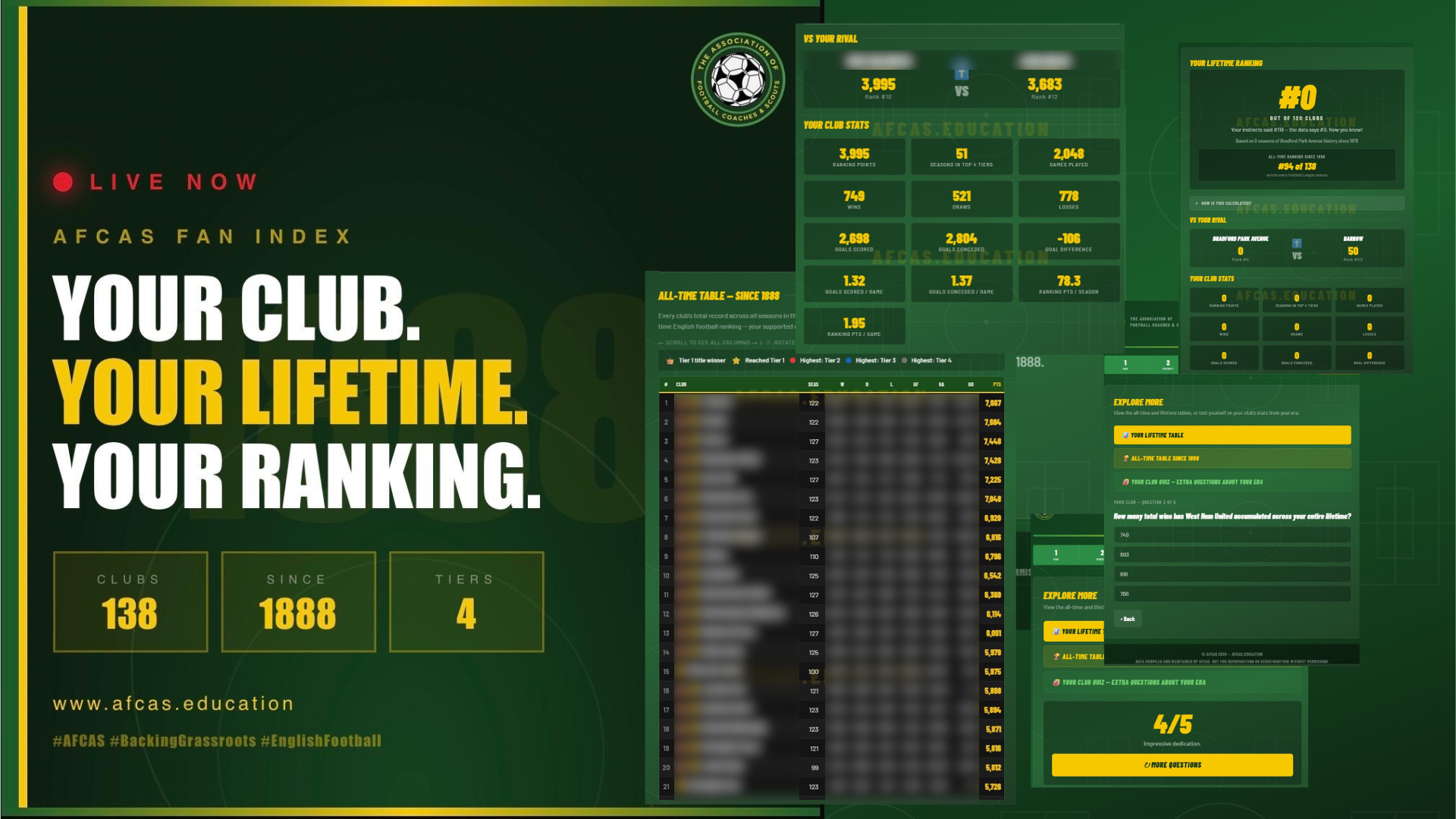
The AFCAS Fan Index: What It Is, How It Works, and Why We Built It
Every supporter’s relationship with their club is completely unique. A lot of that comes down to when you were born.
Imagine two fans of the same club, sitting in the same stand, watching the same game — born forty years apart. Same club. Same badge. Entirely different journey.
A Manchester City fan born in 1996 has grown up watching one of the most dominant sides in English football history. A Manchester City fan born in 1955 has a completely different story to tell. The football they’ve lived through, and the club they’ve experienced, could hardly be more different.
The AFCAS Fan Index exists to give both of those experiences the context they deserve, and to place every fan’s lived experience within the full, unbroken history of English football since 1888.

What Is the AFCAS Fan Index?
The AFCAS Fan Index is a free interactive tool that calculates your personal English football ranking based on two things: your birth year and your club.
It draws on over 135 years of Football League data, every season, every club, every tier, every finishing position, and produces a lifetime ranking that reflects exactly how your club has performed across your era as a supporter.
You don’t need to know anything about data or statistics. You enter your birth year, select your club, and the tool does the rest. Within seconds you’ll have a personalised ranking, a lifetime score, and the context to understand exactly what it means.
You can try it free at www.afcas.education/fan-index
Where the Fan Index Comes From
At AFCAS – the Association of Football Coaches and Scouts – football history sits at the heart of everything we do. From grassroots pitches on a Sunday morning to the upper reaches of the professional game, we work hard to understand and celebrate the full story of English football.
That appreciation for history is where the Fan Index begins. The data to explore that history properly has never really been pulled together in one accessible place — until now. Every Football League season since 1888. Every club. Every tier. Every finishing position. Nothing quite like this has existed for supporters before.
The Fan Index puts all of that in your hands.
How the Fan Index Ranking System Works
Each season, every club earns points based on their finishing position across the tiers of the Football League. The points are relative to the total number of clubs in the league that season – so as the Football League has grown over time, so have the maximum and minimum scores available.
In the modern era:
- Finishing 1st in the Premier League (Tier 1) earns 92 points
- Finishing last in League Two (Tier 4) earns 1 point
- Every club in between earns a score that reflects precisely where they finished relative to the rest of the Football League that season
Your lifetime total accumulates across every season since you were born, scored fairly against the league structure as it existed at the time. A league title in 1925 is worth as much, relative to its era, as a title today.
The tool covers all available tiers in every era:
- One tier from 1888
- Two tiers from 1892
- Three tiers from 1921
- Four tiers from 1958 onwards
The scoring isn’t artificially capped, it reflects whatever structure existed in each season, which is why the points available per season have grown as the league has expanded over time.
Your era starts from the season that begins in your birth year. If you were born in 1977, any month, any day, your era starts from the 1977/78 season. Your lifetime score is then compared against all 122 clubs with sufficient data across the full dataset.
Please note: the National League (Tier 5) is not currently included in the dataset.
What Makes the Fan Index Different from a League Table
The Fan Index is not a league table. It is not a record of current form. It is not a measure of which club is most successful right now.
It is a measure of accumulated history — yours, and your club’s.
That distinction matters enormously, because it restores a perspective the modern game tends to obscure. Football moves in cycles. Clubs that aren’t household names today may have been giants of their era. Clubs riding high at the moment have often spent long periods in the lower tiers. That historical context gets lost when we only look at football through the lens of the present.
The Fan Index restores it.
For supporters, it answers a question the current league table never can: where does my club actually stand in the full story of English football?
What the Data Reveals: Surprising Results from 135 Years of Football History
One of the most compelling aspects of building this tool was what emerged once all the data was in one place. Some results confirm what you’d expect. Others are genuinely surprising, and that’s what makes the Fan Index worth exploring.
Clubs That Rank Higher Than You’d Expect
Huddersfield Town are perhaps the most striking example. Currently in League One, their all-time ranking tells a completely different story. Three consecutive First Division titles in the 1920s, the first club in English football history to achieve the feat, contribute a weight of historical points that most modern fans have completely forgotten. The data remembers, even when the headlines don’t.
Preston North End tell a similar story. The original champions of English football, winning the very first Football League title in 1888/89 unbeaten — and without conceding a single goal in the process — their historical footprint in the data is enormous relative to their current Championship position. There is only one club that can claim to have started it all, and the Fan Index reflects that clearly.
Bolton Wanderers sit remarkably high in the all-time rankings despite currently playing in League One. With over a century of Football League history behind them, they rank above clubs that feel considerably more prominent in the modern game, a reminder of how significant a force they were throughout much of the twentieth century.
Notts County, the world’s oldest Football League club, founded in 1862 — rank far higher all-time than their current position in League Two would suggest. More seasons in the database than almost any other club. The history is all there in the data, even if the modern game has moved on.
Clubs Whose Histories Tell a Cyclical Story
Wolverhampton Wanderers and Burnley, both recently in the Premier League, have histories that swing dramatically across all four tiers. The Fan Index makes those cycles visible in a way that is quite striking when you see it laid out across a lifetime.
The Era Effect: How Birth Year Changes Everything
Perhaps the most thought-provoking feature of the Fan Index is how dramatically the same club can produce different scores depending purely on when a supporter was born.
Two fans of the same club, born twenty years apart, may have genuinely different understandings of what that club actually is — shaped entirely by the eras they’ve lived through. A lifelong Leeds United supporter born in 1965 has lived through Don Revie’s great side, European glory, multiple top-flight campaigns, and the subsequent fall through the divisions. A Leeds supporter born in 1990 has a completely different story. Same club, different football lives.
That’s the whole point of the Fan Index.
Modern Clubs and Historical Position
Brighton & Hove Albion and Brentford present a fascinating modern contrast to clubs like Huddersfield or Preston. They are clubs whose golden era is happening right now — accumulating historical points in real time — which makes for a genuinely different story to clubs living, to some extent, on historical capital accumulated decades ago.
Narrow Margins Across Enormous Timescales
Derby County and West Ham United have accumulated almost identical all-time totals despite arriving there via completely different routes, across different numbers of seasons. Two clubs, one destination.
Leeds United and Nottingham Forest are separated by the narrowest of margins in the all-time table, across the entirety of Football League history since 1888. Some rivalries run deeper than supporters realise.
Who Is the AFCAS Fan Index For?
The Fan Index is for anyone who loves English football and wants to understand their club’s place in its history, not just this season, not just this decade, but across the full sweep of the Football League since 1888.
It is particularly valuable for:
- Lifelong supporters who want historical context for their club’s journey
- Football history enthusiasts interested in how English football has evolved across 135+ years
- Fans of lower-league clubs whose historical significance the modern game often overlooks
- Young supporters who want to understand where their club has come from, not just where it is today
- Coaches and scouts working in youth and grassroots football who want to help players and communities understand the broader story of the game
You don’t need to be a statistician. You don’t need to understand data. You just need to love your club and want to understand what your lifetime as a supporter actually means in the context of English football history.
Frequently Asked Questions
Which clubs are included in the Fan Index?
All 122 clubs with sufficient Football League data since 1888 are included. This covers all four tiers of the current English Football League, as well as clubs that have since dropped out of the Football League entirely.
What if my club has never been in the Football League?
Clubs without sufficient Football League data are not currently included in the dataset. The tool is built specifically around the Football League structure.
Is the National League included?
Not in the current version. The Fan Index covers the top four tiers of English football. The National League (Tier 5) is not part of the current dataset.
What birth year range does the tool cover?
The tool covers supporters born from 1888 onwards. The earlier your birth year, the fewer seasons are available, but the data goes back to the very beginning of the Football League.
Is the Fan Index free to use?
Yes. The AFCAS Fan Index is completely free to use at www.afcas.education/fan-index
Can I share my result?
Yes, you can share your personalised ranking directly from the tool.
Try the AFCAS Fan Index
The AFCAS Fan Index is free to use at www.afcas.education/fan-index
Enter your birth year. Pick your club. Find your lifetime ranking, and see where your experience of English football sits within the full story of the game since 1888.
Drop your club and score in the comments. We’d love to know what you find.
The AFCAS Fan Index is built and maintained by the Association of Football Coaches and Scouts. AFCAS provides e-learning for grassroots football coaches and scouts across the UK. Find out more at www.afcas.education
AFCAS – Football Coaching Pathway – https://afcas.education/grassroots-coaching
AFCAS – Football Scouting Pathway – https://afcas.education/football-scouting
Further Reading – Football Scouting: A Beginner’s Guide to Football Scouting
Further Reading – Football Scouting Courses: What should you expect from a Scout Education Provider
Further Reading – Football Scouting: Assessing A Player – ‘The Eye Test’ In Football Scouting

Originally published by AFCAS – Association of Football Coaches and Scouts
The coaching frameworks, scouting methodologies, player assessment models and educational content contained within the AFCAS Education Hub have been developed from the practical experiences of AFCAS educators working within grassroots, academy, professional and international football.
Original AFCAS Educational Content
The educational content, coaching principles, scouting methodologies and practical frameworks published within the AFCAS Education Hub have been developed through years of professional coaching, scouting and recruitment experience.
These articles represent original AFCAS educational material and are protected by copyright. Any reproduction, adaptation or commercial use without written permission is prohibited.
Please support original football education by sharing links to the original AFCAS articles rather than reproducing their content.
© AFCAS. All Rights Reserved.
About the Author
Ged Searson is the Managing Director of AFCAS and has over 30 years of coaching and scouting experience. He is a former Premier League First Team Scout, former EFL scout and former Chief Scout of the Malawi National Team. Through AFCAS, he has educated coaches and scouts from across the UK and around the world.
Published: 26 June 2026
Author: Ged Searson
Updated: 27 June 2026